Ch 12: Rotation of a Rigid Body
Knight Calc - Physics for Scientists and Engineers 5th Edition
Knight Calc5th EditionPhysics for Scientists and EngineersISBN: 9780137344796당신이 사용하는 게 아니라요?교과서 변경
12장, 문제 3b

A ceiling fan with 80-cm-diameter blades is turning at 60 rpm. Suppose the fan coasts to a stop 25 s after being turned off. Through how many revolutions does the fan turn while stopping?

검증된 단계별 안내
1
Step 1: Identify the given values. The diameter of the fan blades is 80 cm, so the radius is 40 cm (0.4 m). The initial angular velocity \( \omega_0 \) is given as 60 rpm, which needs to be converted to radians per second: \( \omega_0 = 60 \times \frac{2\pi}{60} = 2\pi \ \text{rad/s} \). The time to stop \( t \) is 25 s, and the final angular velocity \( \omega_f \) is 0 rad/s since the fan comes to rest.
Step 2: Use the kinematic equation for rotational motion to find the angular acceleration \( \alpha \): \( \omega_f = \omega_0 + \alpha t \). Rearrange to solve for \( \alpha \): \( \alpha = \frac{\omega_f - \omega_0}{t} \). Substitute the known values: \( \alpha = \frac{0 - 2\pi}{25} \).
Step 3: Use the rotational kinematic equation to find the total angular displacement \( \theta \) in radians: \( \theta = \omega_0 t + \frac{1}{2} \alpha t^2 \). Substitute the known values for \( \omega_0 \), \( \alpha \), and \( t \): \( \theta = (2\pi)(25) + \frac{1}{2} \left( \frac{-2\pi}{25} \right)(25^2) \).
Step 4: Simplify the expression for \( \theta \) to calculate the total angular displacement in radians. Note that \( \theta \) will be the sum of the initial term and the deceleration term. Ensure proper handling of the negative sign for \( \alpha \).
Step 5: Convert the angular displacement \( \theta \) from radians to revolutions. Since one revolution corresponds to \( 2\pi \) radians, divide \( \theta \) by \( 2\pi \): \( \text{Revolutions} = \frac{\theta}{2\pi} \). This will give the total number of revolutions the fan completes while stopping.

비슷한 문제에 대한 검증된 영상 답변:

이 영상 해법은 위 문제에 도움이 된다고 튜터들이 추천한 것입니다.
영상 길이:
7m

주요 개념

질문에 올바르게 답하기 위해 반드시 이해해야 하는 핵심 개념들은 다음과 같습니다.

Angular Velocity

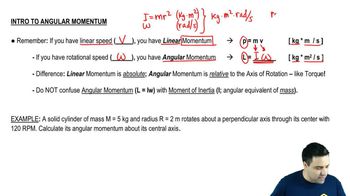
Angular velocity is a measure of how quickly an object rotates around an axis, typically expressed in radians per second or revolutions per minute (rpm). In this scenario, the ceiling fan's initial angular velocity can be calculated from its given speed of 60 rpm, which can be converted to radians per second for further calculations.
추천 영상:
가이드 코스
06:18
Intro to Angular Momentum

Angular Deceleration

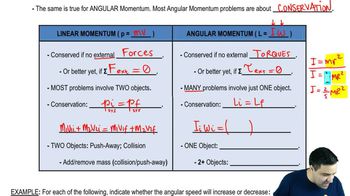
Angular deceleration refers to the rate at which an object's angular velocity decreases over time. When the fan is turned off, it experiences a negative angular acceleration, which can be calculated using the time it takes to stop and the initial angular velocity. This deceleration is crucial for determining how many revolutions the fan makes while coming to a stop.
추천 영상:
가이드 코스
12:12
Conservation of Angular Momentum

Kinematic Equations for Rotational Motion

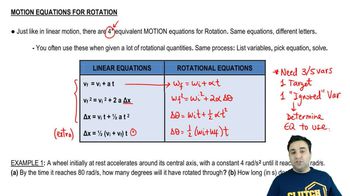
Kinematic equations for rotational motion are analogous to linear motion equations and relate angular displacement, initial angular velocity, angular acceleration, and time. These equations can be used to calculate the total number of revolutions the fan makes while stopping by integrating the effects of angular deceleration over the time interval of 25 seconds.
추천 영상:
가이드 코스
07:18
Equations of Rotational Motion