
The two blocks in FIGURE CP12.86 are connected by a massless rope that passes over a pulley. The pulley is 12 cm in diameter and has a mass of 2.0 kg. As the pulley turns, friction at the axle exerts a torque of magnitude 0.50 N m. If the blocks are released from rest, how long does it take the 4.0 kg block to reach the floor?
Ch 12: Rotation of a Rigid Body
12장, 문제 91b
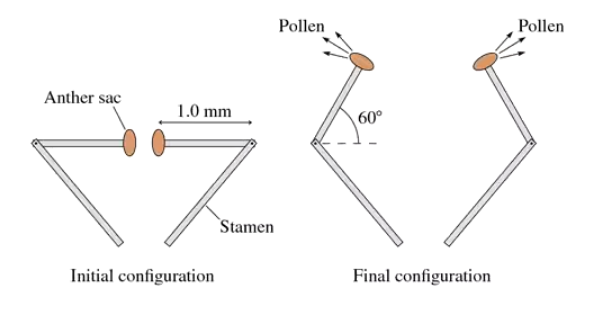
The bunchberry flower has the fastest-moving parts ever observed in a plant. Initially, the stamens are held by the petals in a bent position, storing elastic energy like a coiled spring. When the petals release, the tips of the stamen act like medieval catapults, flipping through a 60° angle in just 0.30 ms to launch pollen from anther sacs at their ends. The human eye just sees a burst of pollen; only high-speed photography reveals the details. As FIGURE CP12.91 shows, we can model the stamen tip as a 1.0-mm-long, 10 μg rigid rod with a 10 μg anther sac at the end. Although oversimplifying, we'll assume a constant angular acceleration. What is the speed of the anther sac as it releases its pollen?

검증된 단계별 안내1
Step 1: Identify the given values and the target variable. The problem provides the angular displacement (θ = 60° = π/3 radians), the time interval (Δt = 0.30 ms = 0.0003 s), and the mass and length of the stamen tip and anther sac. The goal is to find the linear speed of the anther sac at the moment of release.
Step 2: Relate angular acceleration to angular displacement and time. Use the kinematic equation for rotational motion: , where θ is the angular displacement, α is the angular acceleration, and t is the time. Rearrange to solve for α: .
Step 3: Calculate the angular velocity at the moment of release using the angular acceleration. Use the equation , where ω is the angular velocity, α is the angular acceleration, and t is the time.
Step 4: Relate the linear speed of the anther sac to its angular velocity. The linear speed v is given by , where r is the distance from the axis of rotation to the anther sac (1.0 mm = 0.001 m).
Step 5: Substitute the values for ω and r into the equation for v to find the linear speed of the anther sac. Ensure all units are consistent (e.g., radians for angular measurements, seconds for time, meters for length).

비슷한 문제에 대한 검증된 영상 답변:
이 영상 해법은 위 문제에 도움이 된다고 튜터들이 추천한 것입니다.
영상 길이:
6m주요 개념
질문에 올바르게 답하기 위해 반드시 이해해야 하는 핵심 개념들은 다음과 같습니다.
Angular Motion
Angular motion refers to the rotation of an object around an axis. In this context, the stamen tips of the bunchberry flower rotate through a specific angle, which can be analyzed using angular kinematics. Understanding angular motion is crucial for determining the relationship between angular displacement, angular acceleration, and the resulting linear speed of the anther sac as it moves.
추천 영상:
가이드 코스
Angular Momentum of Objects in Linear Motion
Elastic Potential Energy
Elastic potential energy is the energy stored in an object when it is deformed, such as when the stamens are bent by the petals. This energy is released when the petals open, allowing the stamen tips to rapidly accelerate. The conversion of elastic potential energy into kinetic energy is fundamental to understanding how the stamen tips achieve their high speeds during pollen release.
추천 영상:
가이드 코스
Potential Energy Graphs
Kinematics of Rigid Bodies
Kinematics of rigid bodies involves the study of the motion of solid objects without considering the forces that cause the motion. In this scenario, we can model the stamen tip as a rigid rod undergoing angular acceleration. By applying kinematic equations for rotational motion, we can calculate the final linear speed of the anther sac as it is propelled by the rapid movement of the stamen tip.
추천 영상:
가이드 코스
Free-Body Diagrams
관련 실천
교과서 질문
1930
views
3
rank
교과서 질문
A rod of length L and mass M has a nonuniform mass distribution. The linear mass density (mass per length) is λ = cx2, where x is measured from the center of the rod and c is a constant. Find an expression for c in terms of L and M.
1794
views
교과서 질문
A rod of length L and mass M has a nonuniform mass distribution. The linear mass density (mass per length) is λ = cx2 , where x is measured from the center of the rod and c is a constant. Find an expression in terms of L and M for the moment of inertia of the rod for rotation about an axis through the center.
1586
views
