Ch 14: Fluids and Elasticity
Knight Calc - Physics for Scientists and Engineers 5th Edition
Knight Calc5th EditionPhysics for Scientists and EngineersISBN: 9780137344796당신이 사용하는 게 아니라요?교과서 변경
14장, 문제 72

The bottom of a steel 'boat' is a 5.0 m x 10 m x 2.0 cm piece of steel (psteel = 7900 kg/m³). The sides are made of 0.50-cm-thick steel. What minimum height must the sides have for this boat to float in perfectly calm water?

검증된 단계별 안내
1
Step 1: Calculate the volume of the steel bottom of the boat. The dimensions are given as 5.0 m x 10 m x 2.0 cm. Convert the thickness from cm to meters (2.0 cm = 0.02 m). The volume of the bottom is calculated using the formula: \( V_{bottom} = \text{length} \times \text{width} \times \text{thickness} \).
Step 2: Calculate the mass of the steel bottom using the density of steel \( \rho_{steel} = 7900 \; \text{kg/m}^3 \). Use the formula: \( m_{bottom} = \rho_{steel} \times V_{bottom} \).
Step 3: Calculate the volume of the steel sides. The sides are made of 0.50 cm thick steel (convert to meters: 0.50 cm = 0.005 m). Assume the sides form a rectangular box with height \( h \), and calculate the volume of all four sides using the formula: \( V_{sides} = 2 \times (\text{length} \times \text{thickness} \times h) + 2 \times (\text{width} \times \text{thickness} \times h) \).
Step 4: Calculate the mass of the steel sides using the density of steel \( \rho_{steel} \). Use the formula: \( m_{sides} = \rho_{steel} \times V_{sides} \).
Step 5: Apply the principle of buoyancy to determine the minimum height \( h \) of the sides for the boat to float. The total mass of the boat (bottom + sides) must be equal to the mass of the water displaced. Use the formula: \( \text{mass of displaced water} = \text{density of water} \times \text{volume of displaced water} \), where \( \text{volume of displaced water} = \text{base area} \times h \). Solve for \( h \).

비슷한 문제에 대한 검증된 영상 답변:

이 영상 해법은 위 문제에 도움이 된다고 튜터들이 추천한 것입니다.
영상 길이:
11m

주요 개념

질문에 올바르게 답하기 위해 반드시 이해해야 하는 핵심 개념들은 다음과 같습니다.

Buoyancy

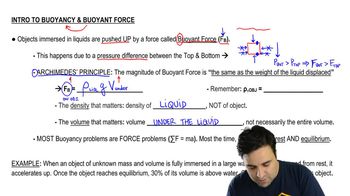
Buoyancy is the upward force exerted by a fluid on an object submerged in it. This force is equal to the weight of the fluid displaced by the object, as described by Archimedes' principle. For an object to float, the buoyant force must equal the weight of the object. In this case, the boat's design must ensure that the weight of the steel is balanced by the buoyant force when submerged to a certain height.
추천 영상:
가이드 코스
11:06
Intro to Buoyancy & Buoyant Force

Density

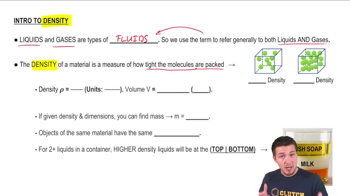
Density is defined as mass per unit volume and is a critical factor in determining whether an object will float or sink. The density of the steel used in the boat (7900 kg/m³) is significantly greater than that of water (approximately 1000 kg/m³). This difference in density means that the boat must displace enough water to create a buoyant force that can support its weight, which is influenced by the dimensions of the sides of the boat.
추천 영상:
가이드 코스
8:13
Intro to Density

Volume Displacement

Volume displacement refers to the volume of fluid that is moved out of the way by an object when it is placed in the fluid. The volume of water displaced by the submerged part of the boat must equal the weight of the boat for it to float. The height of the sides of the boat directly affects how much water is displaced, thus determining the minimum height required for the boat to float in calm water.
추천 영상:
가이드 코스
05:21
Volume Thermal Expansion
관련 실천
교과서 질문

The 30-cm-long left coronary artery is 4.6 mm in diameter. Blood pressure drops by 3.0 mm of mercury over this distance. What are the (a) average blood speed and (b) volume flow rate in L/min through this artery?

1697
views

교과서 질문

The tank shown in FIGURE CP14.73 is completely filled with a liquid of density ρ. The right face is not permanently attached to the tank but, instead, is held against a rubber seal by the tension in a spring. To prevent leakage, the spring must both pull with sufficient strength and prevent a torque from pushing the bottom of the right face out. What minimum spring tension is needed?

2090
views
교과서 질문

The tank shown in FIGURE CP14.73 is completely filled with a liquid of density ρ. The right face is not permanently attached to the tank but, instead, is held against a rubber seal by the tension in a spring. To prevent leakage, the spring must both pull with sufficient strength and prevent a torque from pushing the bottom of the right face out. If the spring has the minimum tension, at what height d from the bottom must it be attached?

1674
views
교과서 질문

The 1.0-m-tall cylinder shown in FIGURE CP14.71 contains air at a pressure of 1 atm. A very thin, frictionless piston of negligible mass is placed at the top of the cylinder to prevent any air from escaping, then mercury is slowly poured into the cylinder until no more can be added without the cylinder overflowing. What is the height h of the column of compressed air? Hint: Boyle's law, which you learned in chemistry, says p₁V₁ = p₂V₂ for a gas compressed at constant temperature, which we will assume to be the case.

2342
views
교과서 질문

In FIGURE CP14.74, a cone of density ρ0 and total height l floats in a liquid of density ρf. The height of the cone above the liquid is h. What is the ratio h/l of the exposed height to the total height?

2145
views
교과서 질문

20°C water flows at 1.5 m/s through a 10-m-long, 1.0-mm-diameter horizontal tube and then exits into the air. What is the gauge pressure in kPa at the point where the water enters the tube?

1908
views