A container holds 1.0 g of oxygen at a pressure of 8.0 atm. How much will the temperature increase if this amount of heat energy is transferred to the gas at constant volume?
Ch 19: Work, Heat, and the First Law of Thermodynamics
19장, 문제 28a
A container holds 1.0 g of oxygen at a pressure of 8.0 atm. How much heat is required to increase the temperature by 100°C at constant pressure?
검증된 단계별 안내1
Step 1: Identify the relevant formula for heat transfer at constant pressure. The heat required can be calculated using the formula: , where is the heat, is the number of moles, is the molar heat capacity at constant pressure, and is the temperature change.
Step 2: Calculate the number of moles of oxygen gas. Use the molar mass of oxygen, which is approximately 32 g/mol. The number of moles is given by , where is the mass of the gas (1.0 g) and is the molar mass (32 g/mol).
Step 3: Look up the molar heat capacity at constant pressure for oxygen gas. For diatomic gases like oxygen, is approximately 29 J/(mol·K).
Step 4: Determine the temperature change in Kelvin. Since the problem specifies a temperature increase of 100°C, and the size of a degree is the same in Celsius and Kelvin, the temperature change is K.
Step 5: Substitute the values into the formula . Use the calculated number of moles, the molar heat capacity, and the temperature change to find the heat required. Ensure the units are consistent throughout the calculation.

비슷한 문제에 대한 검증된 영상 답변:
이 영상 해법은 위 문제에 도움이 된다고 튜터들이 추천한 것입니다.
주요 개념
질문에 올바르게 답하기 위해 반드시 이해해야 하는 핵심 개념들은 다음과 같습니다.
Ideal Gas Law
The Ideal Gas Law relates the pressure, volume, temperature, and number of moles of a gas through the equation PV = nRT. This law is essential for understanding how gases behave under different conditions, particularly when changes in temperature and pressure occur. In this question, it helps to establish the relationship between the gas's properties as heat is added.
추천 영상:
가이드 코스
Ideal Gases and the Ideal Gas Law
Specific Heat Capacity
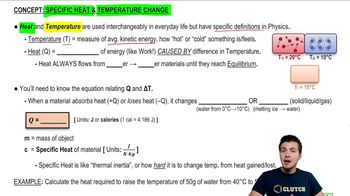
Specific heat capacity is the amount of heat required to raise the temperature of a unit mass of a substance by one degree Celsius. For gases, this value can vary depending on whether the process occurs at constant pressure or volume. In this scenario, the specific heat capacity at constant pressure (Cp) is crucial for calculating the heat required to achieve the desired temperature increase.
추천 영상:
가이드 코스
Specific Heat & Temperature Changes
First Law of Thermodynamics
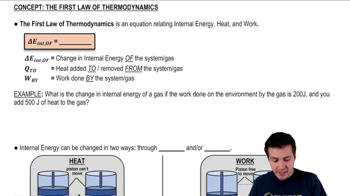
The First Law of Thermodynamics states that energy cannot be created or destroyed, only transformed. In the context of this question, it implies that the heat added to the gas will result in a change in internal energy and work done by the gas, particularly since the process occurs at constant pressure. Understanding this principle is vital for calculating the heat transfer involved in the temperature change.
추천 영상:
가이드 코스
The First Law of Thermodynamics
관련 실천
교과서 질문
195
views
교과서 질문
A 65 cm3 block of iron is removed from an 800°C furnace and immediately dropped into 200 mL of 20°C water. What fraction of the water boils away?
1595
views
교과서 질문
A gas cylinder holds 0.10 mol of O₂ at 150°C and a pressure of 3.0 atm. The gas expands adiabatically until the pressure is halved. What are the final volume?
261
views
교과서 질문
A monatomic gas follows the process 1→2→3 shown in FIGURE EX19.26. How much heat is needed for (a) process 1→2 and (b) process 2→3?
248
views
교과서 질문
10 g of steam at the boiling point are combined with 50 g of ice at the freezing point. What is the final temperature of the system?
1611
views
교과서 질문
A gas cylinder holds 0.10 mol of O₂ at 150°C and a pressure of 3.0 atm. The gas expands adiabatically until the pressure is halved. What are the final temperature?
1051
views