Ch 19: Work, Heat, and the First Law of Thermodynamics
Knight Calc - Physics for Scientists and Engineers 5th Edition
Knight Calc5th EditionPhysics for Scientists and EngineersISBN: 9780137344796당신이 사용하는 게 아니라요?교과서 변경
19장, 문제 34

The ends of a 20-cm-long, 2.0-cm-diameter rod are maintained at 0°C and 100°C by immersion in an ice-water bath and boiling water. Heat is conducted through the rod at 4.5×10⁴ J per hour. Of what material is the rod made?

검증된 단계별 안내
1
Step 1: Identify the formula for heat conduction. The rate of heat transfer through a rod is given by Fourier's law: Q/t = kA(ΔT/L), where Q/t is the heat transfer rate, k is the thermal conductivity of the material, A is the cross-sectional area, ΔT is the temperature difference, and L is the length of the rod.
Step 2: Convert the given dimensions into SI units. The length of the rod is 20 cm, which is 0.2 \, m. The diameter is 2.0 cm, which is 0.02 \, m. The radius is half the diameter, r = 0.01 \, m. The cross-sectional area is calculated using the formula for the area of a circle: A = \, \(\text{π}\)r^2.
Step 3: Substitute the known values into the formula. The heat transfer rate is given as Q/t = 4.5 \, × \, 10^4 \, J/hr. Convert this to watts (joules per second) by dividing by 3600 seconds per hour: Q/t = 4.5 \, × \, 10^4 / 3600 \, W. The temperature difference is ΔT = 100 \, °C - 0 \, °C = 100 \, °C, which is equivalent to 100 K.
Step 4: Rearrange the formula to solve for the thermal conductivity k. Using k = (Q/t) \, × \, (L / (A \, × \, ΔT)), substitute the values for Q/t, L, A, and ΔT.
Step 5: Compare the calculated thermal conductivity k to known values for materials such as copper, aluminum, or steel to identify the material of the rod.

비슷한 문제에 대한 검증된 영상 답변:

이 영상 해법은 위 문제에 도움이 된다고 튜터들이 추천한 것입니다.
영상 길이:
5m

주요 개념

질문에 올바르게 답하기 위해 반드시 이해해야 하는 핵심 개념들은 다음과 같습니다.

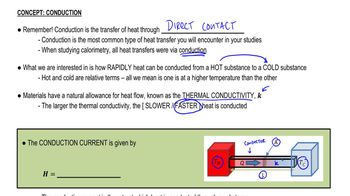
Heat Conduction

Heat conduction is the process by which thermal energy is transferred through a material without any movement of the material itself. It occurs due to the interaction of particles within the material, where faster-moving particles transfer energy to slower-moving ones. The rate of heat conduction is described by Fourier's law, which states that the heat transfer rate is proportional to the temperature gradient and the area through which heat is conducted.
추천 영상:

Thermal Conductivity

Thermal conductivity is a material property that quantifies how well a material conducts heat. It is defined as the amount of heat that passes through a unit area of the material per unit time for a given temperature difference. Different materials have different thermal conductivities, which can be used to identify the material of the rod in the question by comparing the calculated conductivity with known values for various substances.
추천 영상:

Temperature Gradient

The temperature gradient is the rate of temperature change in a given direction within a material. It is calculated as the difference in temperature between two points divided by the distance between them. In the context of heat conduction, a larger temperature gradient results in a higher rate of heat transfer, as heat flows from the hotter region to the cooler region until thermal equilibrium is reached.
추천 영상:
가이드 코스
04:54
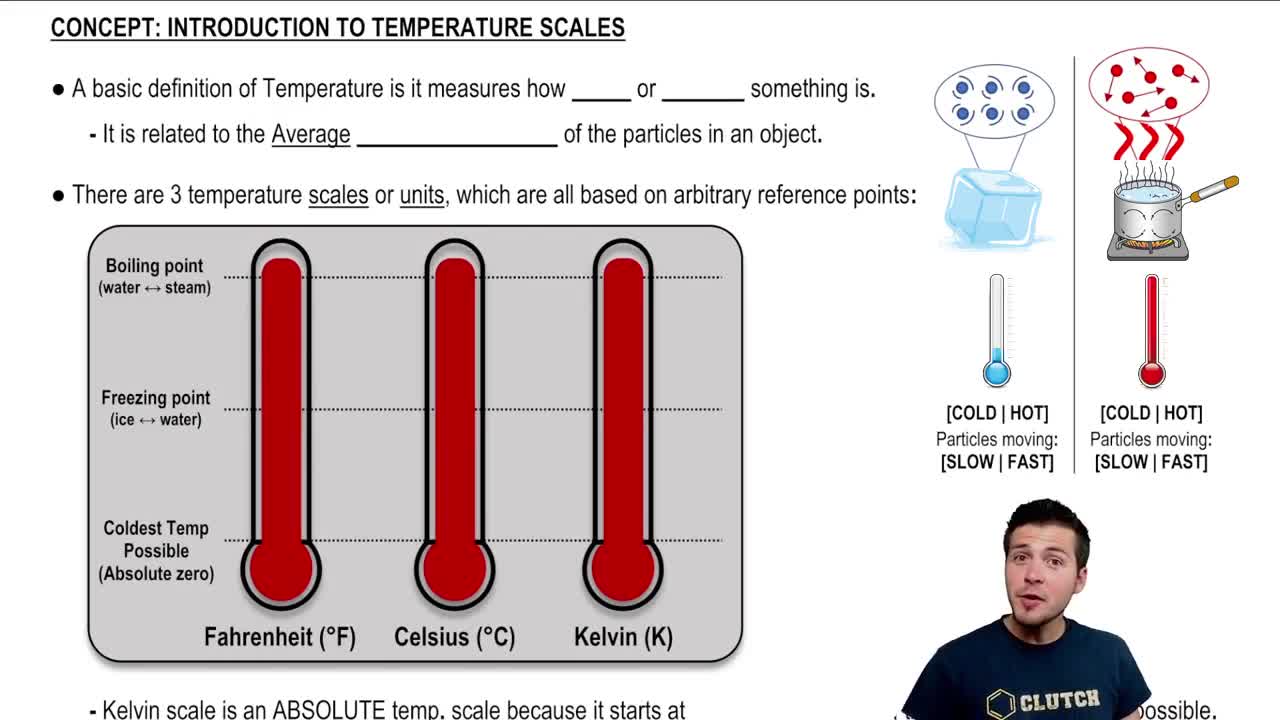
Introduction To Temperature Scales