Ch 19: Work, Heat, and the First Law of Thermodynamics
Knight Calc - Physics for Scientists and Engineers 5th Edition
Knight Calc5th EditionPhysics for Scientists and EngineersISBN: 9780137344796당신이 사용하는 게 아니라요?교과서 변경
19장, 문제 19a

Two cars collide head-on while each is traveling at 80 km/h. Suppose all their kinetic energy is transformed into the thermal energy of the wrecks. What is the temperature increase of each car? You can assume that each car's specific heat is that of iron.

검증된 단계별 안내
1
Step 1: Convert the speed of each car from km/h to m/s. Use the conversion factor: 1 km/h = 1000 m/3600 s.
Step 2: Calculate the kinetic energy of each car using the formula: Ek = (1/2) m v2, where m is the mass of the car and v is its velocity in m/s.
Step 3: Assume all the kinetic energy is converted into thermal energy. Use the formula for heat transfer: Q = m c ΔT, where Q is the thermal energy, m is the mass of the car, c is the specific heat capacity of iron, and ΔT is the temperature increase.
Step 4: Rearrange the heat transfer formula to solve for the temperature increase: ΔT = Q / (m c). Substitute the value of Q (kinetic energy of the car), m (mass of the car), and c (specific heat capacity of iron, approximately 450 J/(kg·°C)).
Step 5: Perform the calculation using the values provided or assumed for the mass of the car and the specific heat capacity of iron to determine the temperature increase of each car.

비슷한 문제에 대한 검증된 영상 답변:

이 영상 해법은 위 문제에 도움이 된다고 튜터들이 추천한 것입니다.
영상 길이:
4m

주요 개념

질문에 올바르게 답하기 위해 반드시 이해해야 하는 핵심 개념들은 다음과 같습니다.

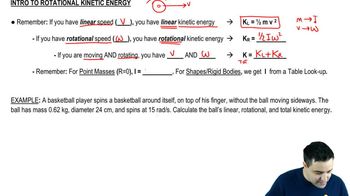
Kinetic Energy

Kinetic energy is the energy an object possesses due to its motion, calculated using the formula KE = 1/2 mv², where m is mass and v is velocity. In the context of the collision, each car has kinetic energy based on its speed of 80 km/h. This energy is crucial for understanding how much thermal energy is generated during the collision.
추천 영상:
가이드 코스
06:07
Intro to Rotational Kinetic Energy

Conservation of Energy

The principle of conservation of energy states that energy cannot be created or destroyed, only transformed from one form to another. In this scenario, the kinetic energy of the moving cars is converted entirely into thermal energy upon collision, which is essential for calculating the resulting temperature increase of the wrecks.
추천 영상:
가이드 코스
06:24
Conservation Of Mechanical Energy

Specific Heat Capacity

Specific heat capacity is the amount of heat required to raise the temperature of a unit mass of a substance by one degree Celsius. For this problem, the specific heat of iron is used to determine how much the temperature of each car increases after the collision, given the total thermal energy produced from the kinetic energy conversion.
추천 영상:
가이드 코스
06:50
Specific Heat & Temperature Changes
관련 실천
교과서 질문

What is the maximum mass of ethyl alcohol you could boil with 1000 J of heat, starting from 20°C?

857
views

교과서 질문

How much heat energy must be added to a 6.0-cm-diameter copper sphere to raise its temperature from −50°C to 150°C?

1445
views
교과서 질문

30 g of copper pellets are removed from a 300°C oven and immediately dropped into 100 mL of water at 20°C in an insulated cup. What will the new water temperature be?

1760
views
교과서 질문

One way you keep from overheating is by perspiring. Evaporation—a phase change—requires heat, and the heat energy is removed from your body. Evaporation is much like boiling, only water's heat of vaporization at 35°C is a somewhat larger 24×105 J/kg because at lower temperatures more energy is required to break the molecular bonds. Very strenuous activity can cause an adult human to produce 30 g of perspiration per minute. If all the perspiration evaporates, rather than dripping off, at what rate (in J/s) is it possible to exhaust heat by perspiring?

104
views
교과서 질문

An experiment measures the temperature of a 500 g substance while steadily supplying heat to it. FIGURE EX19.20 shows the results of the experiment. What are the heats of fusion and vaporization?

782
views
교과서 질문

A 750 g aluminum pan is removed from the stove and plunged into a sink filled with 10.0 L of water at 20.0°C . The water temperature quickly rises to 24.0°C. What was the initial temperature of the pan in °C and in °F?

1419
views