At 100℃ the rms speed of nitrogen molecules is 576 m/s. Nitrogen at 100℃ and a pressure of 2.0 atm is held in a container with a 10 cm x 10 cm square wall. Estimate the rate of molecular collisions (collisions/s) on this wall.
Ch 20: The Micro/Macro Connection
20장, 문제 13
A cylinder contains gas at a pressure of 2.0 atm and a number density of 4.2 x 1025 m-3. The rms speed of the atoms is 660 m/s. Identify the gas.
검증된 단계별 안내1
Step 1: Use the ideal gas law in terms of number density to relate pressure, number density, and temperature. The formula is: , where is pressure, is number density, is Boltzmann's constant (), and is temperature.
Step 2: Rearrange the formula to solve for temperature: . Substitute the given values for pressure (, converted to Pascals as ), number density (), and Boltzmann's constant.
Step 3: Use the formula for the root mean square (rms) speed of gas molecules: , where is the mass of one molecule of the gas. Rearrange the formula to solve for : . Substitute the values for and .
Step 4: Convert the molecular mass to molar mass using Avogadro's number (). The molar mass is given by: , where is Avogadro's number.
Step 5: Compare the calculated molar mass to known molar masses of common gases to identify the gas. For example, if the molar mass is approximately 4 g/mol, the gas is likely helium; if it is approximately 28 g/mol, the gas is likely nitrogen.

비슷한 문제에 대한 검증된 영상 답변:
이 영상 해법은 위 문제에 도움이 된다고 튜터들이 추천한 것입니다.
영상 길이:
7m주요 개념
질문에 올바르게 답하기 위해 반드시 이해해야 하는 핵심 개념들은 다음과 같습니다.
Ideal Gas Law
The Ideal Gas Law relates the pressure, volume, temperature, and number of moles of a gas through the equation PV = nRT. This law is fundamental in understanding the behavior of gases under various conditions and can help identify the type of gas based on its properties.
추천 영상:
가이드 코스
Ideal Gases and the Ideal Gas Law
Root Mean Square Speed (rms speed)
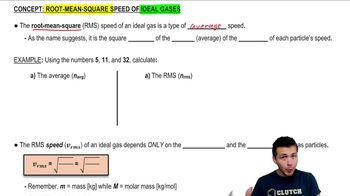
The root mean square speed is a measure of the average speed of particles in a gas and is given by the formula v_rms = √(3kT/m), where k is the Boltzmann constant, T is the temperature, and m is the mass of a gas particle. This concept is crucial for determining the molecular mass of the gas when combined with other properties.
추천 영상:
가이드 코스
Root-Mean-Square Speed of Ideal Gases
Number Density
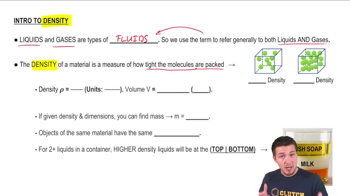
Number density refers to the number of particles per unit volume, typically expressed in particles per cubic meter (m⁻³). It is an important parameter in gas physics, as it helps relate the macroscopic properties of the gas, such as pressure and temperature, to the microscopic behavior of its particles.
추천 영상:
가이드 코스
Intro to Density
관련 실천
교과서 질문
2100
views
교과서 질문
By what factor does the rms speed of a molecule change if the temperature is increased from 10℃ to 1000℃?
1503
views
교과서 질문
The molecules in a six-particle gas have velocities:
Calculate (a) , (b) , and (c) .
1762
views
교과서 질문
1.0 mol of argon has 3100 J of thermal energy. What is the gas temperature in °C?
1862
views
교과서 질문
Eleven molecules have speeds 15, 16, 17, …, 25 m/s. Calculate (a) vavg and (b) vrms.
1248
views
교과서 질문
The rms speed of molecules in a gas is 600 m/s. What will be the rms speed if the gas pressure and volume are both halved?
1851
views