

Ch 20: The Micro/Macro Connection
Knight Calc - Physics for Scientists and Engineers 5th Edition
Knight Calc5th EditionPhysics for Scientists and EngineersISBN: 9780137344796당신이 사용하는 게 아니라요?교과서 변경
20장, 문제 26

The rms speed of the atoms in a 2.0 g sample of helium gas is 700 m/s. What is the thermal energy of the gas?

검증된 단계별 안내
1
Step 1: Recall the formula for the root-mean-square (rms) speed of gas particles: 3kTm, where k is the Boltzmann constant, T is the temperature, and m is the mass of a single atom.
Step 2: Rearrange the formula to solve for the temperature T: T=mv23k, where v is the rms speed.
Step 3: Determine the mass of a single helium atom. The molar mass of helium is approximately 4.00 g/mol, and the mass of one atom is 4.00×10-336.022×10²³ kg.
Step 4: Use the formula for the total thermal energy of a monatomic ideal gas: E=3nRT2, where n is the number of moles, R is the gas constant, and T is the temperature.
Step 5: Calculate the number of moles in the 2.0 g sample of helium using n=mM, where m is the mass of the sample and M is the molar mass. Substitute the values into the thermal energy formula to find the result.

비슷한 문제에 대한 검증된 영상 답변:

이 영상 해법은 위 문제에 도움이 된다고 튜터들이 추천한 것입니다.

주요 개념

질문에 올바르게 답하기 위해 반드시 이해해야 하는 핵심 개념들은 다음과 같습니다.

Root Mean Square Speed

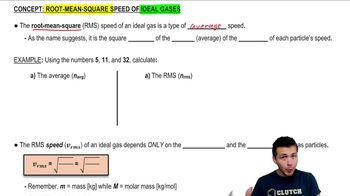
The root mean square (rms) speed is a statistical measure of the speed of particles in a gas. It is calculated as the square root of the average of the squares of the speeds of the individual particles. This concept is crucial for understanding the kinetic energy of gas particles, as it relates directly to their thermal motion and energy distribution.
추천 영상:
가이드 코스
05:21
Root-Mean-Square Speed of Ideal Gases

Thermal Energy

Thermal energy refers to the total kinetic energy of the particles in a substance due to their motion. In the context of gases, it can be calculated using the formula E = (3/2)nRT, where n is the number of moles, R is the ideal gas constant, and T is the temperature in Kelvin. Understanding thermal energy is essential for analyzing the energy content of gases and their behavior under different conditions.
추천 영상:
가이드 코스
05:21
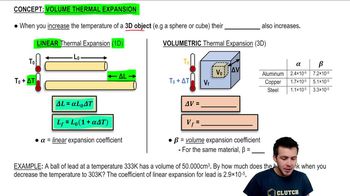
Volume Thermal Expansion

Ideal Gas Law

The Ideal Gas Law is a fundamental equation in thermodynamics that relates the pressure, volume, temperature, and number of moles of an ideal gas. It is expressed as PV = nRT. This law is important for calculating various properties of gases, including thermal energy, and helps in understanding how changes in one variable affect the others in a gas system.
추천 영상:
가이드 코스
07:21
Ideal Gases and the Ideal Gas Law