Ch 23: The Electric Field
Knight Calc - Physics for Scientists and Engineers 5th Edition
Knight Calc5th EditionPhysics for Scientists and EngineersISBN: 9780137344796당신이 사용하는 게 아니라요?교과서 변경
23장, 문제 3

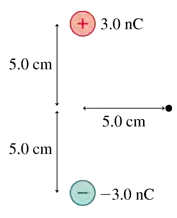
What are the strength and direction of the electric field at the position indicated by the dot in FIGURE EX23.3? Specify the direction as an angle cw from horizontal.
Diagram showing two charges, +3.0 nC above and -3.0 nC below, with a dot indicating the electric field's strength and direction.

검증된 단계별 안내
1
Step 1: Understand the problem. The dot represents the point where the electric field strength and direction need to be calculated. The electric field at a point due to a charge is given by the formula: E=kqr2, where k is Coulomb's constant (8.99×10⁹N·m2/C2), q is the charge, and r is the distance from the charge to the point.
Step 2: Calculate the electric field due to the positive charge. The positive charge is 3.0nC and is located 5.0cm vertically above the dot. Convert the distance to meters: 5.0×10⁻²m. Use the formula for electric field to find the magnitude of the field due to this charge.
Step 3: Calculate the electric field due to the negative charge. The negative charge is -3.0nC and is located 5.0cm vertically below the dot. Again, convert the distance to meters and use the formula for electric field to find the magnitude of the field due to this charge.
Step 4: Determine the direction of the electric fields. The electric field due to the positive charge points away from the positive charge, while the electric field due to the negative charge points toward the negative charge. Both fields are vertical, one pointing downward and the other upward. Calculate the net vertical component of the electric field.
Step 5: Combine the vertical and horizontal components of the electric field. The horizontal component comes from the horizontal distance between the dot and the charges. Use vector addition to find the resultant electric field and calculate its direction as an angle clockwise from the horizontal using trigonometry (tan¯(verticalhorizontal)).

비슷한 문제에 대한 검증된 영상 답변:

이 영상 해법은 위 문제에 도움이 된다고 튜터들이 추천한 것입니다.

주요 개념

질문에 올바르게 답하기 위해 반드시 이해해야 하는 핵심 개념들은 다음과 같습니다.

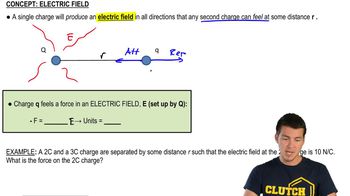
Electric Field

The electric field is a vector field that represents the force exerted by an electric charge on other charges in its vicinity. It is defined as the force per unit charge and is directed away from positive charges and toward negative charges. The strength of the electric field (E) can be calculated using the formula E = F/q, where F is the force experienced by a test charge q placed in the field.
추천 영상:
가이드 코스
03:16
Intro to Electric Fields

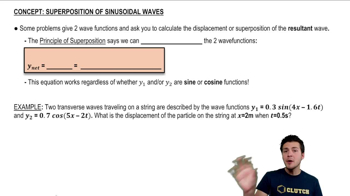
Superposition Principle

The superposition principle states that the total electric field created by multiple charges is the vector sum of the electric fields produced by each charge independently. This means that to find the net electric field at a point, one must calculate the electric field due to each charge and then add these vectorially, taking into account their magnitudes and directions.
추천 영상:
가이드 코스
03:32
Superposition of Sinusoidal Wave Functions

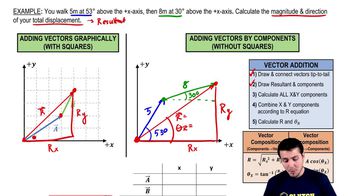
Vector Components

Vectors can be broken down into their components along the axes of a coordinate system, typically the x and y axes. This is crucial for analyzing electric fields, as the direction of the field can be expressed in terms of its horizontal and vertical components. The angle of the resultant vector can then be determined using trigonometric functions, allowing for a clear understanding of the field's direction.
추천 영상:
가이드 코스
07:30
Vector Addition By Components