
Ch 25: The Electric Potential
Knight Calc - Physics for Scientists and Engineers 5th Edition
Knight Calc5th EditionPhysics for Scientists and EngineersISBN: 9780137344796당신이 사용하는 게 아니라요?교과서 변경
25장, 문제 80

Bead A has a mass of 15 g and a charge of −5.0 nC. Bead B has a mass of 25 g and a charge of −10.0 nC. The beads are held 12 cm apart (measured between their centers) and released. What maximum speed is achieved by each bead?

검증된 단계별 안내
1
Convert the given quantities into SI units: mass of bead A (\(m_A = 15\,\text{g} = 0.015\,\text{kg}\)), mass of bead B (\(m_B = 25\,\text{g} = 0.025\,\text{kg}\)), charges (\(q_A = -5.0\,\text{nC} = -5.0 \times 10^{-9}\,\text{C}\), \(q_B = -10.0\,\text{nC} = -10.0 \times 10^{-9}\,\text{C}\)), and distance (\(r = 12\,\text{cm} = 0.12\,\text{m}\)).
Determine the initial electric potential energy of the system using the formula \(U = \frac{k \cdot |q_A \cdot q_B|}{r}\), where \(k = 8.99 \times 10^9\,\text{N·m}^2/\text{C}^2\) is Coulomb's constant. Substitute the values to calculate \(U\).
Since the beads are released from rest, their initial kinetic energy is zero. By conservation of energy, the total initial energy (electric potential energy) will be converted into the total kinetic energy of the system. Write the equation: \(U = \frac{1}{2} m_A v_A^2 + \frac{1}{2} m_B v_B^2\), where \(v_A\) and \(v_B\) are the speeds of beads A and B, respectively.
Use the principle of conservation of momentum to relate the velocities of the two beads. Since the system is initially at rest and no external forces act on it, the total momentum remains zero: \(m_A v_A = m_B v_B\). Solve for one velocity in terms of the other, e.g., \(v_B = \frac{m_A}{m_B} v_A\).
Substitute \(v_B = \frac{m_A}{m_B} v_A\) into the energy conservation equation. Solve for \(v_A\) and \(v_B\) algebraically. This will give the maximum speeds of beads A and B.

비슷한 문제에 대한 검증된 영상 답변:

이 영상 해법은 위 문제에 도움이 된다고 튜터들이 추천한 것입니다.

주요 개념

질문에 올바르게 답하기 위해 반드시 이해해야 하는 핵심 개념들은 다음과 같습니다.

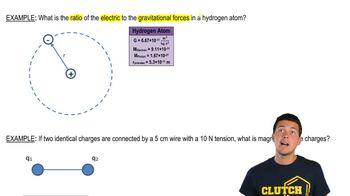
Coulomb's Law

Coulomb's Law describes the electrostatic force between two charged objects. It states that the force is directly proportional to the product of the magnitudes of the charges and inversely proportional to the square of the distance between them. This principle is essential for calculating the initial force acting on the beads due to their charges before they are released.
추천 영상:

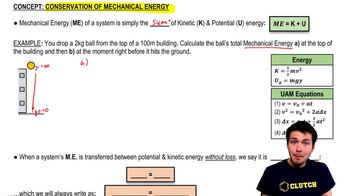
Conservation of Energy

The principle of conservation of energy states that energy cannot be created or destroyed, only transformed from one form to another. In this scenario, the potential energy due to the electrostatic force between the beads will convert into kinetic energy as they move apart. Understanding this concept allows us to relate the initial potential energy to the maximum kinetic energy achieved by each bead.
추천 영상:
가이드 코스
06:24
Conservation Of Mechanical Energy

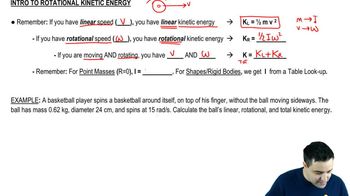
Kinetic Energy

Kinetic energy is the energy possessed by an object due to its motion, calculated using the formula KE = 1/2 mv², where m is mass and v is velocity. In this problem, once the beads are released, their potential energy will convert into kinetic energy, allowing us to determine the maximum speed of each bead based on their respective masses and the energy transformation.
추천 영상:
가이드 코스
06:07
Intro to Rotational Kinetic Energy