A 2.0-cm-diameter parallel-plate capacitor with a spacing of 0.50 mm is charged to 200 V. What are (a) the total energy stored in the electric field and (b) the energy density?
Ch 26: Potential and Field
26장, 문제 29
You need a capacitance of 50 μF, but you don't happen to have a 50 μF capacitor. You do have a 75 μF capacitor. What additional capacitor do you need to produce a total capacitance of 50 μF? Should you join the two capacitors in parallel or in series?
검증된 단계별 안내1
To determine the configuration (series or parallel), recall the formulas for equivalent capacitance: For capacitors in series, the reciprocal of the total capacitance is given by: . For capacitors in parallel, the total capacitance is the sum: .
Since the desired total capacitance (50 μF) is less than the capacitance of the given capacitor (75 μF), the capacitors must be connected in series. This is because connecting capacitors in series reduces the total capacitance.
Using the series formula, substitute the known values: . Here, is the capacitance of the additional capacitor.
Rearrange the equation to solve for : . Perform the subtraction on the right-hand side to find the reciprocal of .
Finally, take the reciprocal of the result to find the value of . This is the capacitance of the additional capacitor needed to achieve a total capacitance of 50 μF when connected in series with the 75 μF capacitor.

비슷한 문제에 대한 검증된 영상 답변:
이 영상 해법은 위 문제에 도움이 된다고 튜터들이 추천한 것입니다.
주요 개념
질문에 올바르게 답하기 위해 반드시 이해해야 하는 핵심 개념들은 다음과 같습니다.
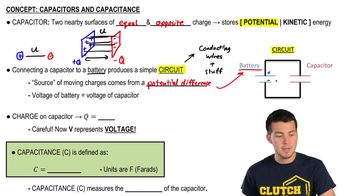
Capacitance in Series
When capacitors are connected in series, the total capacitance (C_total) is less than the smallest individual capacitor. The formula for total capacitance in series is given by 1/C_total = 1/C1 + 1/C2 + ... + 1/Cn. This means that adding capacitors in series effectively increases the voltage rating while decreasing the overall capacitance.
추천 영상:
가이드 코스
Capacitors & Capacitance (Intro)
Capacitance in Parallel
In a parallel configuration, the total capacitance is the sum of the individual capacitances. The formula is C_total = C1 + C2 + ... + Cn. This arrangement allows the capacitors to share the same voltage across their terminals, resulting in a higher total capacitance while maintaining the same voltage rating as the individual capacitors.
추천 영상:
가이드 코스
Capacitors & Capacitance (Intro)
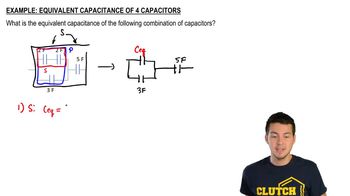
Finding Equivalent Capacitance
To achieve a desired capacitance using available capacitors, one must understand how to combine them effectively. In this case, to reach a total capacitance of 50 μF using a 75 μF capacitor, one would need to connect an additional capacitor in series. The required capacitance can be calculated using the series capacitance formula to find the value of the additional capacitor needed.
추천 영상:
가이드 코스
Find Equivalent Capacitance #1
관련 실천
교과서 질문
173
views
교과서 질문
50 pJ of energy is stored in a 2.0 cm×2.0 cm×2.0 cm region of uniform electric field. What is the electric field strength?
67
views
교과서 질문
A 6 μF capacitor, a 10 μF capacitor, and a 16 μF capacitor are connected in series. What is their equivalent capacitance?
283
views
교과서 질문
The electric field in a region of space is Ex=5000x V/m , where x is in meters. Find an expression for the potential V at position x. As a reference, let V=0 V at the origin.
2070
views
교과서 질문
What is the equivalent capacitance of the three capacitors in FIGURE EX26.27?
1757
views
교과서 질문
A switch that connects a battery to a 10 μF capacitor is closed. Several seconds later you find that the capacitor plates are charged to ±30 μC. What is the emf of the battery?
1661
views