A 100 A current circulates around a 2.0-mm-diameter superconducting ring. What is the ring's magnetic dipole moment?
Ch 29: The Magnetic Field
29장, 문제 6
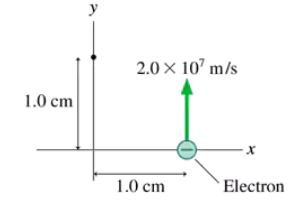
What is the magnetic field at the position of the dot in FIGURE EX29.6? Give your answer as a vector.

검증된 단계별 안내1
Step 1: Identify the configuration of the current-carrying wires in FIGURE EX29.6. Determine the direction of the current in each wire and their relative positions to the dot where the magnetic field is to be calculated.
Step 2: Use the Biot-Savart Law or Ampere's Law to calculate the magnetic field contribution from each wire at the position of the dot. The Biot-Savart Law states: , where is the permeability of free space, is the current, and is the distance from the wire to the point of interest.
Step 3: Determine the direction of the magnetic field produced by each wire using the right-hand rule. For a straight current-carrying wire, point your thumb in the direction of the current, and your curled fingers will indicate the direction of the magnetic field around the wire.
Step 4: Add the magnetic field vectors from each wire at the position of the dot. Since magnetic fields are vector quantities, consider both the magnitude and direction of each field contribution. Use vector addition to combine the fields.
Step 5: Express the resultant magnetic field at the dot as a vector in terms of its components (e.g., ). Ensure the direction and magnitude are consistent with the vector addition performed in the previous step.

비슷한 문제에 대한 검증된 영상 답변:
이 영상 해법은 위 문제에 도움이 된다고 튜터들이 추천한 것입니다.
영상 길이:
6m주요 개념
질문에 올바르게 답하기 위해 반드시 이해해야 하는 핵심 개념들은 다음과 같습니다.
Magnetic Field
The magnetic field is a vector field that describes the magnetic influence on moving electric charges, electric currents, and magnetic materials. It is represented by the symbol B and is measured in teslas (T). The direction of the magnetic field is defined as the direction a north pole of a magnet would move, and its strength can vary depending on the source and distance from it.
추천 영상:
가이드 코스
Magnetic Fields and Magnetic Dipoles
Vector Representation
A vector is a quantity that has both magnitude and direction. In the context of magnetic fields, representing the magnetic field as a vector means specifying both its strength and the direction in which it acts. This is crucial for understanding how the magnetic field interacts with charged particles and other magnetic fields, as the effects depend on both the magnitude and orientation of the vectors involved.
추천 영상:
가이드 코스
Adding 3 Vectors in Unit Vector Notation
Biot-Savart Law
The Biot-Savart Law is a fundamental principle used to calculate the magnetic field generated by a current-carrying conductor. It states that the magnetic field dB at a point in space is proportional to the current I, the length element of the conductor, and the sine of the angle between the current element and the line connecting the element to the point, divided by the square of the distance from the element to the point. This law is essential for determining the magnetic field at specific locations in complex configurations.
추천 영상:
가이드 코스
Biot-Savart Law with Calculus
관련 실천
교과서 질문
76
views
교과서 질문
What are the magnetic fields at points a to c in FIGURE EX29.13? Give your answers as vectors.
268
views
교과서 질문
A proton moves along the x-axis with vₓ = 1.0 x 10⁷ m/s. As it passes the origin, what are the strength and direction of the magnetic field at the (x, y, z) positions (a) (1 cm, 0 cm, 0 cm), (b) (0 cm, 1 cm, 0 cm), and (c) (0 cm, -2 cm, 0 cm)?
1390
views
교과서 질문
The element niobium, which is a metal, is a superconductor (i.e., no electrical resistance) at temperatures below 9 K. However, the superconductivity is destroyed if the magnetic field at the surface of the metal reaches or exceeds 0.10 T. What is the maximum current in a straight, 3.0-mm-diameter superconducting niobium wire?
197
views