Ch 36: Special Relativity
Knight Calc - Physics for Scientists and Engineers 5th Edition
Knight Calc5th EditionPhysics for Scientists and EngineersISBN: 9780137344796당신이 사용하는 게 아니라요?교과서 변경
36장, 문제 66

At what speed, as a fraction of c, is the kinetic energy of a particle twice its Newtonian value?

검증된 단계별 안내
1
Understand the problem: The goal is to find the speed (v) of a particle, expressed as a fraction of the speed of light (c), where the relativistic kinetic energy is twice the classical (Newtonian) kinetic energy. This involves comparing relativistic and classical kinetic energy expressions.
Write the expression for relativistic kinetic energy: \( KE_{rel} = (\gamma - 1)m c^2 \), where \( \gamma = \frac{1}{\sqrt{1 - \frac{v^2}{c^2}}} \) is the Lorentz factor, \( m \) is the mass of the particle, and \( c \) is the speed of light.
Write the expression for classical kinetic energy: \( KE_{classical} = \frac{1}{2} m v^2 \).
Set up the condition given in the problem: \( KE_{rel} = 2 \cdot KE_{classical} \). Substituting the expressions, this becomes \( (\gamma - 1)m c^2 = 2 \cdot \frac{1}{2} m v^2 \), which simplifies to \( (\gamma - 1)c^2 = v^2 \).
Substitute \( \gamma = \frac{1}{\sqrt{1 - \frac{v^2}{c^2}}} \) into the equation \( (\gamma - 1)c^2 = v^2 \), and solve for \( v \) as a fraction of \( c \). This involves algebraic manipulation to isolate \( v \) in terms of \( c \).

비슷한 문제에 대한 검증된 영상 답변:

이 영상 해법은 위 문제에 도움이 된다고 튜터들이 추천한 것입니다.

주요 개념

질문에 올바르게 답하기 위해 반드시 이해해야 하는 핵심 개념들은 다음과 같습니다.

Kinetic Energy in Classical Mechanics

In classical mechanics, the kinetic energy (KE) of an object is given by the formula KE = 1/2 mv², where m is the mass and v is the velocity. This formula assumes that speeds are much less than the speed of light (c) and does not account for relativistic effects. As the speed of an object approaches c, the classical formula becomes inadequate.
추천 영상:
가이드 코스
06:07
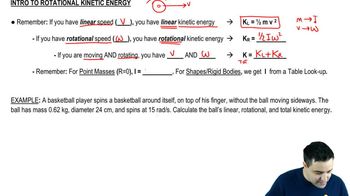
Intro to Rotational Kinetic Energy

Relativistic Kinetic Energy

In relativistic physics, the kinetic energy of a particle is expressed as KE = (γ - 1)mc², where γ (gamma) is the Lorentz factor defined as γ = 1 / √(1 - v²/c²). This formula accounts for the effects of relativity, which become significant at speeds close to the speed of light. As velocity increases, the kinetic energy increases more rapidly than predicted by classical mechanics.
추천 영상:
가이드 코스
06:07
Intro to Rotational Kinetic Energy

Lorentz Factor

The Lorentz factor (γ) is a crucial concept in relativity that describes how time, length, and relativistic mass change for an object moving relative to an observer. It is defined as γ = 1 / √(1 - v²/c²). As the speed of an object approaches the speed of light, γ increases significantly, leading to increased relativistic effects, including a rise in kinetic energy beyond classical predictions.
추천 영상:
가이드 코스
14:16
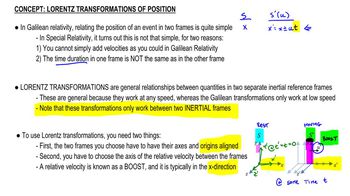
Lorentz Transformations of Position
관련 실천
교과서 질문

A rocket is fired from the earth to the moon at a speed of 0.990c. Let two events be 'rocket leaves earth' and 'rocket hits moon.' In the earth's reference frame, calculate ∆x, ∆t, and the spacetime interval s for these events.

52
views

교과서 질문

Let's examine whether or not the law of conservation of momentum is true in all reference frames if we use the Newtonian definition of momentum: px = mux. Consider an object A of mass 3m at rest in reference frame S. Object A explodes into two pieces: object B, of mass m, that is shot to the left at a speed of c/2 and object C, of mass 2m, that, to conserve momentum, is shot to the right at a speed of c/4. Suppose this explosion is observed in reference frame S' that is moving to the right at half the speed of light. Use the Lorentz velocity transformation to find the velocities and the Newtonian momenta of B and C in S'.

114
views
교과서 질문

The sun radiates energy at the rate 3.8 x 1026 W. The source of this energy is fusion, a nuclear reaction in which mass is transformed into energy. The mass of the sun is 2.0 x 1030 kg. Fusion takes place in the core of a star, where the temperature and pressure are highest. A star like the sun can sustain fusion until it has transformed about 0.10% of its total mass into energy, then fusion ceases and the star slowly dies. Estimate the sun's lifetime, giving your answer in billions of years.

93
views
교과서 질문

The sun radiates energy at the rate 3.8 x 1026 W. The source of this energy is fusion, a nuclear reaction in which mass is transformed into energy. The mass of the sun is 2.0 x 1030 kg. What percent is this of the sun's total mass?

74
views
교과서 질문

A rocket is fired from the earth to the moon at a speed of 0.990c. Let two events be 'rocket leaves earth' and 'rocket hits moon.' Repeat your calculations of part a if the rocket is replaced with a laser beam.

46
views
교과서 질문

The nuclear reaction that powers the sun is the fusion of four protons into a helium nucleus. The process involves several steps, but the net reaction is simply 4p → 4He + energy. The mass of a proton, to four significant figures, is 1.673 x 10⁻²⁷ kg, and the mass of a helium nucleus is known to be 6.644 x 10⁻²⁷ kg. What fraction of the initial rest mass energy is this energy?

153
views