Ch 19: The First Law of Thermodynamics
Young & Freedman Calc - University Physics 14th Edition
Young & Freedman Calc14th EditionUniversity PhysicsISBN: 9780321973610당신이 사용하는 게 아니라요?교과서 변경
19장, 문제 25c

The temperature of 0.1500.150 mol of an ideal gas is held constant at 77.077.0°C while its volume is reduced to 25.0%25.0\% of its initial volume. The initial pressure of the gas is 1.251.25 atm. Does the gas exchange heat with its surroundings? If so, how much? Does the gas absorb or liberate heat?

검증된 단계별 안내
1
First, understand that since the temperature of the gas is held constant, this is an isothermal process. For an ideal gas undergoing an isothermal process, the internal energy change is zero, meaning any heat exchanged is equal to the work done on or by the gas.
Use the ideal gas law, \( PV = nRT \), to relate the initial and final states of the gas. Since the temperature \( T \) and the number of moles \( n \) are constant, the product of pressure \( P \) and volume \( V \) remains constant: \( P_1V_1 = P_2V_2 \).
Given that the final volume \( V_2 \) is 25.0% of the initial volume \( V_1 \), express \( V_2 \) as \( V_2 = 0.25V_1 \). Substitute this into the equation from step 2 to find the final pressure \( P_2 \).
Calculate the work done on the gas using the formula for work in an isothermal process: \( W = nRT \ln\left(\frac{V_2}{V_1}\right) \). Since \( V_2 = 0.25V_1 \), substitute this into the equation to find \( W \).
Since the process is isothermal, the heat exchanged \( Q \) is equal to the work done \( W \). Determine whether the gas absorbs or liberates heat by considering the sign of \( W \). If \( W \) is positive, the gas absorbs heat; if negative, it liberates heat.

비슷한 문제에 대한 검증된 영상 답변:

이 영상 해법은 위 문제에 도움이 된다고 튜터들이 추천한 것입니다.
영상 길이:
5m

주요 개념

질문에 올바르게 답하기 위해 반드시 이해해야 하는 핵심 개념들은 다음과 같습니다.

Ideal Gas Law

The Ideal Gas Law is a fundamental equation in thermodynamics, expressed as PV = nRT, where P is pressure, V is volume, n is the number of moles, R is the ideal gas constant, and T is temperature. It describes the relationship between these variables for an ideal gas, allowing us to predict how a gas will behave under different conditions. In this problem, it helps us understand how pressure and volume changes affect the gas when temperature is constant.
추천 영상:
가이드 코스
07:21
Ideal Gases and the Ideal Gas Law

Isothermal Process

An isothermal process is a thermodynamic process in which the temperature of the system remains constant. For an ideal gas undergoing an isothermal process, the internal energy remains unchanged, and any work done by or on the gas is compensated by heat exchange with the surroundings. This concept is crucial for determining whether the gas exchanges heat with its surroundings when its volume changes at constant temperature.
추천 영상:
가이드 코스
06:13
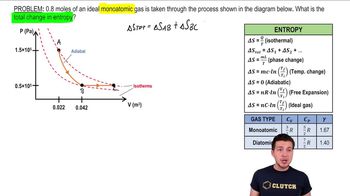
Entropy & Ideal Gas Processes

First Law of Thermodynamics

The First Law of Thermodynamics, also known as the law of energy conservation, states that the change in internal energy of a system is equal to the heat added to the system minus the work done by the system. In an isothermal process for an ideal gas, the internal energy change is zero, so the heat exchanged is equal to the work done. This principle helps us calculate the amount of heat exchanged when the gas volume changes at constant temperature.
추천 영상:
가이드 코스
08:04
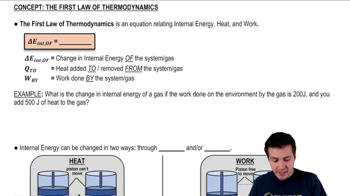
The First Law of Thermodynamics
관련 실천