Ch 20: The Second Law of Thermodynamics
Young & Freedman Calc - University Physics 14th Edition
Young & Freedman Calc14th EditionUniversity PhysicsISBN: 9780321973610당신이 사용하는 게 아니라요?교과서 변경
20장, 문제 16c

A certain brand of freezer is advertised to use 730730 kWh of energy per year. What is the theoretical maximum amount of ice this freezer could make in an hour, starting with water at 20.020.0°C?

검증된 단계별 안내
1
First, determine the energy consumption of the freezer per hour. Since the freezer uses 730 kW•h per year, divide this by the number of hours in a year (365 days * 24 hours/day) to find the energy usage per hour.
Next, calculate the energy required to cool water from 20.0°C to 0°C. Use the specific heat capacity of water, which is approximately 4.18 J/g°C. The formula to use is: \( Q = m \cdot c \cdot \Delta T \), where \( Q \) is the heat energy, \( m \) is the mass of the water, \( c \) is the specific heat capacity, and \( \Delta T \) is the change in temperature.
After cooling the water to 0°C, calculate the energy required to freeze the water. Use the latent heat of fusion for water, which is approximately 334,000 J/kg. The formula is: \( Q = m \cdot L_f \), where \( L_f \) is the latent heat of fusion.
Combine the energy calculations from steps 2 and 3 to find the total energy required to convert water at 20.0°C to ice at 0°C. This is the sum of the energy to cool the water and the energy to freeze it.
Finally, use the energy consumption per hour calculated in step 1 to determine the maximum mass of ice that can be made in one hour. Set the total energy required (from step 4) equal to the energy available per hour and solve for the mass \( m \).

비슷한 문제에 대한 검증된 영상 답변:

이 영상 해법은 위 문제에 도움이 된다고 튜터들이 추천한 것입니다.
영상 길이:
8m

주요 개념

질문에 올바르게 답하기 위해 반드시 이해해야 하는 핵심 개념들은 다음과 같습니다.

Energy Conversion

Energy conversion is the process of changing energy from one form to another. In this context, the freezer converts electrical energy into thermal energy to remove heat from water, turning it into ice. Understanding how energy is converted and utilized is crucial for calculating the amount of ice produced.
추천 영상:
가이드 코스
07:46
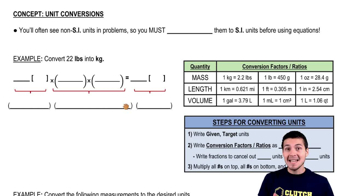
Unit Conversions

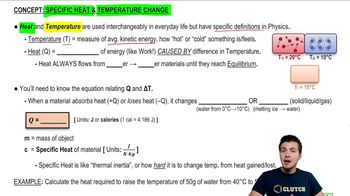
Specific Heat Capacity

Specific heat capacity is the amount of heat required to change the temperature of a unit mass of a substance by one degree Celsius. For water, this value is 4.18 J/g°C. This concept helps determine the energy needed to lower the temperature of water from 20°C to 0°C before freezing.
추천 영상:
가이드 코스
06:50
Specific Heat & Temperature Changes

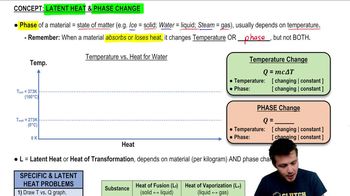
Latent Heat of Fusion

Latent heat of fusion is the energy required to change a substance from solid to liquid or vice versa without changing its temperature. For water, this is 334 J/g. This concept is essential for calculating the energy needed to convert water at 0°C into ice, which is necessary to determine the maximum ice production.
추천 영상:
가이드 코스
10:40
Latent Heat & Phase Changes