

A 6.00-kg piece of solid copper metal at an initial temperature T is placed with 2.00 kg of ice that is initially at -20.0°C. The ice is in an insulated container of negligible mass and no heat is exchanged with the surroundings. After thermal equilibrium is reached, there is 1.20 kg of ice and 0.80 kg of liquid water. What was the initial temperature of the piece of copper?
Ch 17: Temperature and Heat
17장, 문제 7
The pressure of a gas at the triple point of water is atm. If its volume remains unchanged, what will its pressure be at the temperature at which CO2 solidifies?
검증된 단계별 안내1
Identify the initial conditions: The pressure of the gas is 1.35 atm, and the volume remains unchanged. This suggests that we are dealing with a scenario where the volume is constant, which is a key aspect of the problem.
Recognize the relationship between pressure and temperature for a gas at constant volume. According to Gay-Lussac's Law, the pressure of a gas is directly proportional to its temperature when the volume is held constant. This can be expressed as: , where P is pressure and T is temperature.
Determine the temperature at which CO2 solidifies. Carbon dioxide solidifies at a temperature of approximately -78.5°C, which is equivalent to 194.65 K. This is the temperature at which you need to calculate the new pressure.
Use the proportional relationship from Gay-Lussac's Law to set up the equation: . Here, is the initial pressure (1.35 atm), is the initial temperature (273.15 K, the triple point of water), is the final pressure, and is the final temperature (194.65 K).
Solve for the final pressure using the equation: . Substitute the known values to find the pressure at the temperature at which CO2 solidifies.

비슷한 문제에 대한 검증된 영상 답변:
이 영상 해법은 위 문제에 도움이 된다고 튜터들이 추천한 것입니다.
영상 길이:
3m주요 개념
질문에 올바르게 답하기 위해 반드시 이해해야 하는 핵심 개념들은 다음과 같습니다.
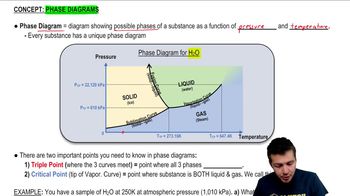
Triple Point
The triple point of a substance is the unique temperature and pressure at which the three phases (gas, liquid, and solid) coexist in equilibrium. For water, this occurs at 0.01°C and 611.657 pascals. Understanding the triple point is crucial for determining phase changes and conditions under which substances transition between states.
추천 영상:
가이드 코스
Phase Diagrams
Ideal Gas Law
The Ideal Gas Law, expressed as PV=nRT, relates the pressure (P), volume (V), and temperature (T) of a gas with its amount in moles (n) and the ideal gas constant (R). It is essential for predicting how changes in temperature affect pressure when volume is constant, assuming the gas behaves ideally.
추천 영상:
가이드 코스
Ideal Gases and the Ideal Gas Law
Phase Transition of CO2
CO2 solidifies at a specific temperature and pressure, known as its sublimation point, which is -78.5°C at 1 atm. Understanding this phase transition is crucial for determining the conditions under which CO2 changes from gas to solid, affecting its pressure if the volume remains constant.
추천 영상:
가이드 코스
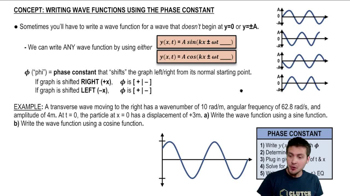
Phase Constant of a Wave Function
관련 실천
교과서 질문
576
views
교과서 질문
Calculate the one temperature at which Fahrenheit and Kelvin thermometers agree with each other
1781
views
교과서 질문
Calculate the one temperature at which Fahrenheit and Celsius thermometers agree with each other.
1934
views
교과서 질문
A geodesic dome constructed with an aluminum framework is a nearly perfect hemisphere; its diameter measures 55.0 m on a winter day at a temperature of -15°C. How much more interior space does the dome have in the summer, when the temperature is 35°C?
1839
views
교과서 질문
A constant-volume gas thermometer registers an absolute pressure corresponding to mm of mercury when in contact with water at the triple point. What pressure does it read when in contact with water at the normal boiling point?
2268
views
