
A uniform electric field exists in the region between two oppositely charged plane parallel plates. A proton is released from rest at the surface of the positively charged plate and strikes the surface of the opposite plate, cm distant from the first, in a time interval of s. Find the magnitude of the electric field.
A proton is traveling horizontally to the right at m/s. How much time does it take the proton to stop after entering the field?
검증된 단계별 안내
비슷한 문제에 대한 검증된 영상 답변:
주요 개념
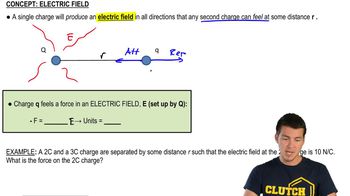
Electric Field
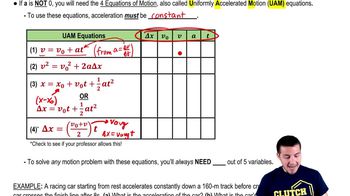
Kinematics
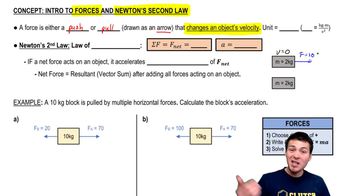
Newton's Second Law
A uniform electric field exists in the region between two oppositely charged plane parallel plates. A proton is released from rest at the surface of the positively charged plate and strikes the surface of the opposite plate, cm distant from the first, in a time interval of s. Find the speed of the proton when it strikes the negatively charged plate.
A proton is traveling horizontally to the right at m/s. Find the magnitude and direction of the weakest electric field that can bring the proton uniformly to rest over a distance of cm.
A -mC point charge is glued down on a horizontal frictionless table. It is tied to a -mC point charge by a light, nonconducting -cm wire. A uniform electric field of magnitude is directed parallel to the wire, as shown in Fig. E. What would the tension be if both charges were negative?
A proton is traveling horizontally to the right at m/s. What minimum field (magnitude and direction) would be needed to stop an electron under the conditions of part (a)? Note: Part (a) asks for how much time does it take the proton to stop after entering the field.
A -mC point charge is glued down on a horizontal frictionless table. It is tied to a -mC point charge by a light, nonconducting -cm wire. A uniform electric field of magnitude is directed parallel to the wire, as shown in Fig. E. Find the tension in the wire.
