 뒤로
뒤로Precalculus Logarithms Flashcards
 7:30
7:30
이 집합의 용어 (19)
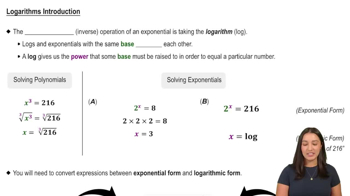
A logarithm answers the question: to what exponent must the base be raised to get a certain number? Formally, \(\log_b a = c\) means \(b^c = a\).
The change of base formula is \(\log_b a = \frac{\log_c a}{\log_c b}\), where c is any positive base (commonly 10 or e).
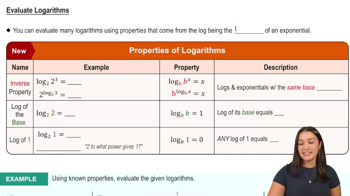
Since \(2^3 = 8\), \(\log_2 8 = 3\).
\(\log_b 1 = 0\) because any base raised to 0 equals 1.
Product rule: \(\log_b (xy) = \log_b x + \log_b y\).
Quotient rule: \(\log_b \left(\frac{x}{y}\right) = \log_b x - \log_b y\).
Power rule: \(\log_b (x^r) = r \log_b x\).
Rewrite as \(\log_b a = x\).
\(\log_b b = 1\) because the base raised to 1 equals itself.
Use common logs: \(\log_2 10 = \frac{\log 10}{\log 2}\) or natural logs: \(\log_2 10 = \frac{\ln 10}{\ln 2}\).
The base must be positive and not equal to 1; the argument must be positive.
Since \(3^3 = 27\), \(\log_3 27 = 3\).
\(\log_b (x^2 y) = 2m + n\) by power and product rules.
The inverse is the exponential function \(b^x\).
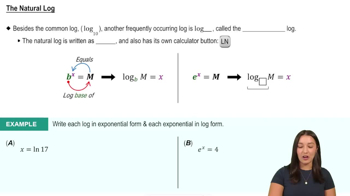
Rewrite as \(x = 5^3 = 125\).
The natural logarithm is the logarithm with base e, written as \(\ln x = \log_e x\).
\(\log_b \frac{1}{a} = -\log_b a\) by the quotient rule.
The domain is (0, \(\infty\)) because the argument must be positive.
\(3 \log_b x + 2 \log_b y\) by power and product rules.