Skip to main content
Introductory Statistics
나의 코스
배우기
시험 준비
AI 튜터
학습 가이드
교과서적 해결책
플래시카드
탐험해 보세요
앱을 사용해 보세요
나의 코스
배우기
시험 준비
AI 튜터
학습 가이드
교과서적 해결책
플래시카드
탐험해 보세요
앱을 사용해 보세요
뒤로
Introductory Statistics: Conditional Probability and Multiplication Rules
1 학생이 이 점이 도움이 되었다고 느꼈습니다
카드를 뒤집기 위해 탭할 수 있습니다.
What is conditional probability?
카드를 뒤집기 위해 탭할 수 있습니다.
👆
What is conditional probability?
Conditional probability is the probability of an event occurring given that another event has already occurred, denoted as
P(F|E)
.
진행 상황 추적
컨트롤 버튼이 '내비게이션' 모드로 변경되었습니다.
1/20
추천 영상
VideoThumbView.guidedCourse
5:37
Introduction to Probability
10990
views
420
rank
1
comments
이 집합의 용어 (20)
하이드의 정의
What is conditional probability?
Conditional probability is the probability of an event occurring given that another event has already occurred, denoted as
P(F|E)
.
How do you calculate the probability of two dependent events both occurring?
Use the general multiplication rule:
P(E and F) = P(E) · P(F|E)
.
What is the multiplication rule for independent events?
For independent events E and F,
P(E and F) = P(E) · P(F)
.
What is the difference between independent and dependent events?
Events are independent if the occurrence of one does not affect the probability of the other; dependent if it does.
What does it mean if two events are disjoint?
Disjoint events have no outcomes in common; if one occurs, the other cannot.
Are disjoint events independent?
No, disjoint events are not independent because knowing one occurs changes the probability of the other to zero.
What is the complement rule in probability?
The complement of event E, denoted
E
c
, is the event that E does not occur, and
P(E) + P(E
c
) = 1
.
How do you calculate the probability of 'at least one' event occurring?
Use the complement rule:
P(at least one) = 1 - P(none)
.
What is the probability that a randomly selected person is a man from the given table?
P(man) = (Number of men) / (Total people) = (1+2) / (1+7+2+3) = 3/13.
What is the probability that a randomly selected person is a male doctor from the table?
P(male doctor) = Number of male doctors / Total people = 2 / 13.
How do you find the probability that a person is a nurse or a doctor?
Add the probabilities of nurses and doctors: P(nurse or doctor) = (1+7+2+3)/13 = 13/13 = 1.
How do you find the probability that a person is a nurse or a woman?
Add probabilities of nurses and women, subtract overlap: P(nurse or woman) = P(nurse) + P(woman) - P(nurse and woman).
What is the probability that a person who is a nurse is a man?
P(man | nurse) = Number of male nurses / Total nurses = 1 / (1+7) = 1/8.
What is the probability that a person is a doctor given that the person is a woman?
P(doctor | woman) = Number of female doctors / Total women = 3 / (7+3) = 3/10.
What is the probability that a person is a woman given that the person is a doctor?
P(woman | doctor) = Number of female doctors / Total doctors = 3 / (2+3) = 3/5.
What is the range of any probability value?
The probability of any event must be between 0 and 1 inclusive:
0 ≤ P(E) ≤ 1
.
What must the sum of probabilities in a sample space equal?
The sum of probabilities of all outcomes in the sample space must equal 1.
What is the formula for the probability of the union of two events E and F if they are not disjoint?
P(E or F) = P(E) + P(F) - P(E and F).
What is the formula for the probability of the union of two disjoint events E and F?
If E and F are disjoint, then P(E or F) = P(E) + P(F).
What is the 5% guideline for assuming independence in sampling?
If the sample size is no more than 5% of the population, treat selections as independent even if sampling without replacement.
 뒤로뒤로
뒤로뒤로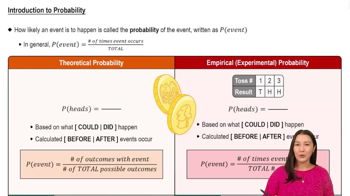
 5:37
5:37