Skip to main content
Introductory Statistics
나의 코스
배우기
시험 준비
AI 튜터
학습 가이드
교과서적 해결책
플래시카드
탐험해 보세요
앱을 사용해 보세요
나의 코스
배우기
시험 준비
AI 튜터
학습 가이드
교과서적 해결책
플래시카드
탐험해 보세요
앱을 사용해 보세요
뒤로
Introductory Statistics: Probability and Counting
카드를 뒤집기 위해 탭할 수 있습니다.
What is a probability experiment?
카드를 뒤집기 위해 탭할 수 있습니다.
👆
What is a probability experiment?
An action or trial where specific results are obtained.
진행 상황 추적
컨트롤 버튼이 '내비게이션' 모드로 변경되었습니다.
1/30
추천 영상
VideoThumbView.guidedCourse
5:37
Introduction to Probability
10958
views
419
rank
1
comments
이 집합의 용어 (30)
하이드의 정의
What is a probability experiment?
An action or trial where specific results are obtained.
Define an outcome in probability.
The result of a single trial in a probability experiment.
What is a sample space?
The set of all possible outcomes in a probability experiment.
What is an event in probability?
One or more outcomes; a subset of the sample space.
State the fundamental counting principle.
If one event can occur in m ways and a second in n ways, the total ways both can occur in sequence is \(m \times n\).
How many 4-digit access codes are possible if digits cannot be repeated?
10 × 9 × 8 × 7 = 5040 possible codes.
How many 4-digit access codes are possible if digits can be repeated?
10 × 10 × 10 × 10 = 10,000 possible codes.
How many 4-digit access codes if the first digit cannot be 0 or 1 but digits can repeat?
8 × 10 × 10 × 10 = 8,000 possible codes.
Define classical (theoretical) probability.
Probability where each outcome in the sample space is equally likely.
Formula for classical probability of event E.
\(P(E) = \frac{\text{Number of outcomes in } E}{\text{Number of outcomes in sample space}}\)
What is empirical (statistical) probability?
Probability based on observed data or relative frequency from experiments.
Formula for empirical probability of event E.
\(P(E) = \frac{\text{Frequency of event } E}{\text{Total frequency}}\)
What is subjective probability?
Probability based on intuition, educated guesses, or estimates.
What is the range of probabilities for any event E?
The probability satisfies \(0 \leq P(E) \leq 1\).
Define the complement of an event E.
All outcomes in the sample space not in event E, denoted
E'
.
Relationship between probabilities of an event and its complement.
\(P(E) + P(E') = 1\)
What is conditional probability?
The probability of event B occurring given event A has occurred, denoted \(P(B|A)\).
Formula for conditional probability of B given A.
\(P(B|A) = \frac{P(A \text{ and } B)}{P(A)}\)
Define independent events.
Events where the occurrence of one does not affect the probability of the other.
Multiplication rule for probability of A and B (dependent events).
\(P(A \text{ and } B) = P(A) \times P(B|A)\)
Multiplication rule for independent events A and B.
\(P(A \text{ and } B) = P(A) \times P(B)\)
What does it mean if two events are mutually exclusive?
They cannot occur at the same time; no outcomes in common.
Addition rule for probability of A or B.
\(P(A \text{ or } B) = P(A) + P(B) - P(A \text{ and } B)\)
Simplified addition rule for mutually exclusive events A and B.
\(P(A \text{ or } B) = P(A) + P(B)\)
Define permutation.
An ordered arrangement of objects.
Formula for number of permutations of n distinct objects.
\(n! = n \times (n-1) \times (n-2) \times ... \times 1\)
What is 0! equal to?
0! = 1 by definition.
Formula for permutations of n objects taken r at a time.
\(nPr = \frac{n!}{(n-r)!}\)
Define combination.
A selection of r objects from n without regard to order.
Formula for combinations of n objects taken r at a time.
\(nCr = \frac{n!}{r! (n-r)!}\)
 뒤로뒤로
뒤로뒤로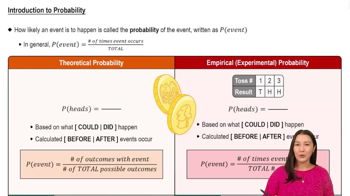
 5:37
5:37