Ch. 7 - Applications of Trigonometry and Vectors
Lial - Trigonometry 12th Edition
Lial12th EditionTrigonometryISBN: 9780136552161, 9780135440780, 9780136881117, 9780135440827, 9780135924891당신이 사용하는 게 아니라요?교과서 변경
8장, 문제 46

A luxury liner leaves port on a bearing of 110.0° and travels 8.8 mi. It then turns due west and travels 2.4 mi. How far is the liner from port, and what is its bearing from port?

검증된 단계별 안내
1
Draw a diagram to visualize the problem: start at the port (point O), draw a line representing the first leg of the journey at a bearing of 110.0° from north, and mark the endpoint after traveling 8.8 miles (point A). Then, from point A, draw a line due west (270°) for 2.4 miles to point B, the liner's final position.
Resolve the first leg of the journey into its north-south and east-west components using trigonometry. Since the bearing is measured clockwise from north, calculate the east (x) and north (y) components as follows: \(x_{A} = 8.8 \times \sin(110.0^\circ)\) \(y_{A} = 8.8 \times \cos(110.0^\circ)\)
Calculate the coordinates of the final position (point B) relative to the port by adjusting the east-west component for the second leg: \(x_{B} = x_{A} - 2.4\) (since the liner travels west, subtract 2.4 miles from the east component) \(y_{B} = y_{A}\) (north-south component remains the same as the second leg is due west).
Find the straight-line distance from the port to the liner's final position using the Pythagorean theorem: \(distance = \sqrt{(x_{B})^{2} + (y_{B})^{2}}\)
Determine the bearing from the port to the liner's final position by calculating the angle relative to north: \(\theta = \arctan\left(\frac{|x_{B}|}{|y_{B}|}\right)\) Adjust the angle based on the quadrant where point B lies to express the bearing as degrees clockwise from north.

비슷한 문제에 대한 검증된 영상 답변:

이 영상 해법은 위 문제에 도움이 된다고 튜터들이 추천한 것입니다.

주요 개념

질문에 올바르게 답하기 위해 반드시 이해해야 하는 핵심 개념들은 다음과 같습니다.

Bearing and Direction in Navigation

Bearing is the direction or path along which something moves, measured in degrees clockwise from the north. Understanding bearings helps translate directional instructions into angles on a coordinate plane, essential for plotting the liner's path and determining its final position relative to the starting point.
추천 영상:
가이드 코스
05:13
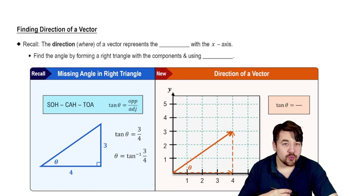
Finding Direction of a Vector

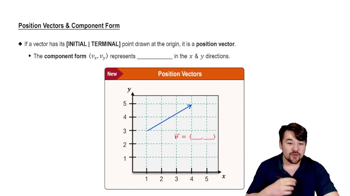
Vector Addition and Components

Vector addition involves combining displacement vectors by breaking them into components along perpendicular axes, typically east-west and north-south. This allows calculation of the resultant displacement by summing components, which is crucial for finding the liner's overall distance and direction from the port.
추천 영상:
가이드 코스
03:55
Position Vectors & Component Form

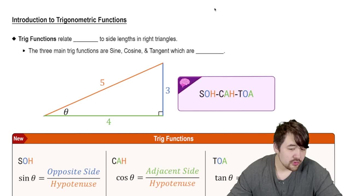
Trigonometric Functions and Resultant Magnitude

Trigonometric functions like sine and cosine relate angles to side lengths in right triangles, enabling calculation of vector components. The Pythagorean theorem then finds the resultant distance, and inverse trigonometric functions determine the bearing angle from the components, completing the solution.
추천 영상:
가이드 코스
6:04
Introduction to Trigonometric Functions