Skip to main content
Analytical Chemistry
나의 코스
배우기
시험 준비
AI 튜터
학습 가이드
플래시카드
탐험해 보세요
앱을 사용해 보세요
나의 코스
배우기
시험 준비
AI 튜터
학습 가이드
플래시카드
탐험해 보세요
앱을 사용해 보세요
뒤로
Chemical Thermodynamics: Entropy quiz
카드를 뒤집기 위해 탭할 수 있습니다.
What does the second law of thermodynamics state about entropy in the universe?
카드를 뒤집기 위해 탭할 수 있습니다.
👆
What does the second law of thermodynamics state about entropy in the universe?
The second law states that the entropy of the universe is always increasing, meaning the universe becomes more disordered over time.
진행 상황 추적
컨트롤 버튼이 '내비게이션' 모드로 변경되었습니다.
1/15
관련 플래시카드
관련 실천
추천 영상
Chemical Thermodynamics: Entropy definitions
Chemical Thermodynamics: Entropy
15 용어
Chemical Thermodynamics: Entropy
6. Chemical Equilibrium
5 문제점
주제
Chemical Thermodynamics: Gibbs Free Energy
6. Chemical Equilibrium
5 문제점
주제
6. Chemical Equilibrium - Part 1 of 3
4 주제
12 문제점
장
6. Chemical Equilibrium - Part 2 of 3
4 주제
12 문제점
장
6. Chemical Equilibrium - Part 3 of 3
2 주제
6 문제점
장
VideoThumbView.guidedCourse
03:22
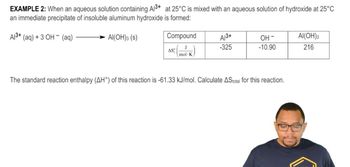
Entropy Calculations 1
360
views
2
rank
1
comments
VideoThumbView.guidedCourse
03:10
Entropy
261
views
3
rank
VideoThumbView.guidedCourse
05:56
Entropy Calculations 1
248
views
2
rank
이 집합의 용어 (15)
하이드의 정의
What does the second law of thermodynamics state about entropy in the universe?
The second law states that the entropy of the universe is always increasing, meaning the universe becomes more disordered over time.
How does entropy change during the phase transition from solid to liquid to gas?
Entropy increases as you move from solid to liquid to gas because the molecular disorder and spacing increase.
What is the sign of delta S when a substance changes from solid to liquid or liquid to gas?
The sign of delta S is positive, indicating an increase in entropy.
What happens to entropy when a substance changes from gas to liquid to solid?
Entropy decreases, so the sign of delta S is negative.
What does the third law of thermodynamics state about entropy at absolute zero?
The third law states that entropy reaches zero at absolute zero (0 Kelvin), where all molecular motion stops.
Why is absolute zero considered theoretical in thermodynamics?
Absolute zero is theoretical because it has never been observed; the lowest natural temperature is about 2 Kelvin.
When comparing covalent compounds, what is the first factor to consider for entropy?
The first factor is the phase of the compound; gases have the highest entropy, solids the lowest.
If covalent compounds are in the same phase, what is the next factor used to compare their entropies?
The next factor is the number of microstates, which relates to the complexity and number of elements in the compound.
How does molecular mass affect entropy when comparing covalent compounds of equal phase and complexity?
Greater molecular mass results in higher entropy.
What is lattice energy in the context of ionic compounds?
Lattice energy is the energy released when one mole of an ionic compound forms from its gaseous ions.
How is lattice energy estimated for ionic compounds?
Lattice energy is estimated by multiplying the absolute values of cation and anion charges and dividing by the sum of their radii (period numbers).
What does a higher lattice energy indicate about an ionic compound's properties?
Higher lattice energy means stronger ionic bonds, higher boiling and melting points, and lower entropy.
What is the trend of lattice energy across the periodic table?
Lattice energy increases as you move toward the top right corner of the periodic table.
Why do gases have higher entropy than solids?
Gases have higher entropy because their molecules are more spread out and disordered compared to solids.
How does the number of elements in a covalent compound affect its entropy?
More elements mean greater complexity, more microstates, and higher entropy.
 뒤로뒤로
뒤로뒤로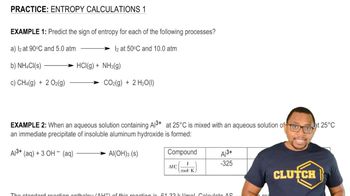
 03:22
03:22