Skip to main content
Analytical Chemistry
나의 코스
배우기
시험 준비
AI 튜터
학습 가이드
플래시카드
탐험해 보세요
앱을 사용해 보세요
나의 코스
배우기
시험 준비
AI 튜터
학습 가이드
플래시카드
탐험해 보세요
앱을 사용해 보세요
뒤로
Chemical Thermodynamics: Gibbs Free Energy definitions
카드를 뒤집기 위해 탭할 수 있습니다.
Gibbs Free Energy
카드를 뒤집기 위해 탭할 수 있습니다.
👆
Gibbs Free Energy
A thermodynamic quantity used to predict if a reaction occurs naturally, calculated from enthalpy and entropy changes.
진행 상황 추적
컨트롤 버튼이 '내비게이션' 모드로 변경되었습니다.
1/15
관련 플래시카드
관련 실천
추천 영상
Chemical Thermodynamics: Gibbs Free Energy quiz #1
Chemical Thermodynamics: Gibbs Free Energy
10 용어
Chemical Thermodynamics: Gibbs Free Energy quiz
Chemical Thermodynamics: Gibbs Free Energy
15 용어
Chemical Thermodynamics: Gibbs Free Energy
6. Chemical Equilibrium
5 문제점
주제
Solubilty Product Constant
6. Chemical Equilibrium
5 문제점
주제
6. Chemical Equilibrium - Part 1 of 3
4 주제
12 문제점
장
6. Chemical Equilibrium - Part 2 of 3
4 주제
12 문제점
장
6. Chemical Equilibrium - Part 3 of 3
2 주제
6 문제점
장
VideoThumbView.guidedCourse
05:36
Gibbs Free Energy
702
views
4
rank
VideoThumbView.guidedCourse
06:37
Gibbs Free Energy Calculations 1
349
views
2
rank
VideoThumbView.guidedCourse
03:05
Gibbs Free Energy
248
views
3
rank
이 집합의 용어 (15)
하이드의 정의
Gibbs Free Energy
A thermodynamic quantity used to predict if a reaction occurs naturally, calculated from enthalpy and entropy changes.
Spontaneous Reaction
A process that proceeds without external energy input, typically with negative Gibbs free energy and positive universe entropy.
Non-Spontaneous Reaction
A process requiring energy input to proceed, characterized by positive Gibbs free energy and negative universe entropy.
Equilibrium
A state where forward and reverse reaction rates are equal, with zero Gibbs free energy change and reaction quotient equal to equilibrium constant.
Entropy
A measure of disorder or randomness, with universe increase favoring spontaneous processes according to the second law of thermodynamics.
Enthalpy
A thermodynamic property representing heat content, used in calculating Gibbs free energy changes.
Equilibrium Constant
A value expressing the ratio of product to reactant concentrations at equilibrium, influencing reaction spontaneity.
Reaction Quotient
A ratio of product to reactant concentrations at any point, indicating direction needed to reach equilibrium.
Standard Conditions
Reference state with 1 atm pressure, 1 M concentration, and 25°C temperature, used for thermodynamic calculations.
Energy Diagram
A graphical representation showing energy changes of reactants and products, with y-axis as Gibbs free energy.
Exergonic Process
A reaction with negative Gibbs free energy, releasing energy and favoring product formation.
Endergonic Process
A reaction with positive Gibbs free energy, requiring energy input and favoring reactant formation.
Gas Constant
A physical constant (8.314 J/mol·K) used in thermodynamic equations involving energy and temperature.
Second Law of Thermodynamics
A principle stating that universe entropy increases in spontaneous processes, guiding reaction direction.
Temperature
A variable, often in Kelvin, affecting Gibbs free energy and reaction spontaneity in thermodynamic equations.
 뒤로뒤로
뒤로뒤로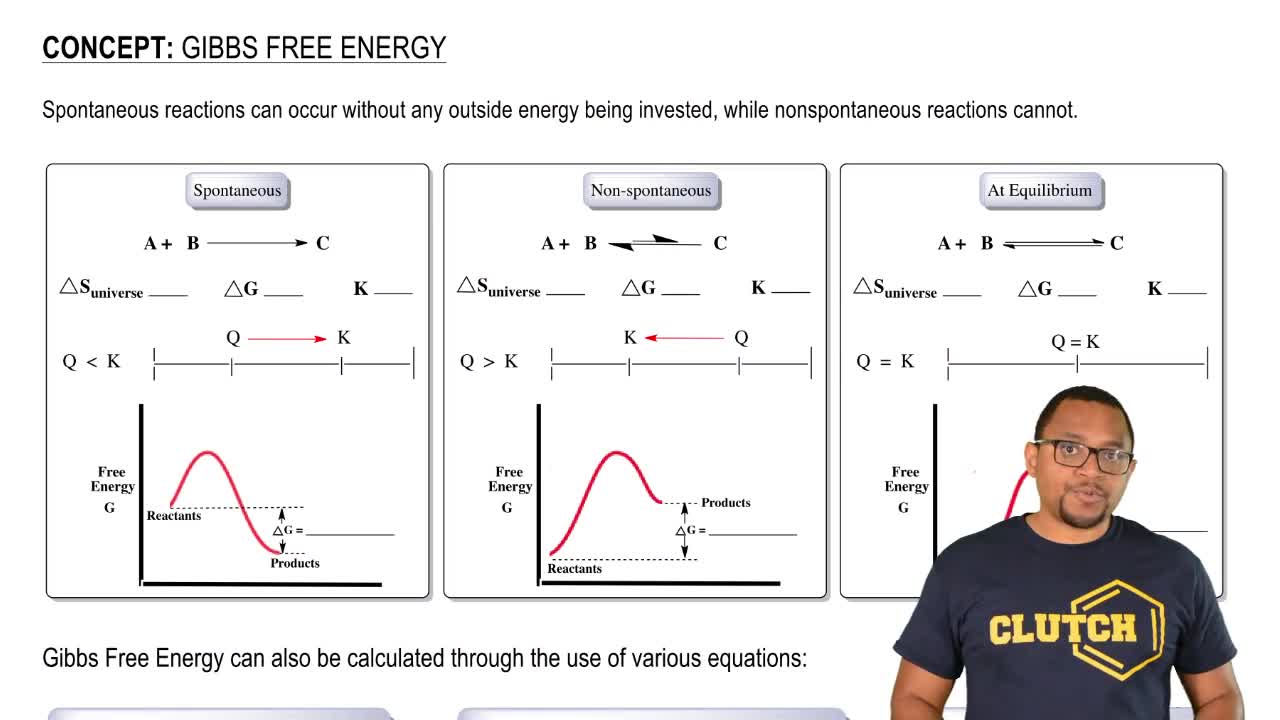
 05:36
05:36