Skip to main content
Analytical Chemistry
나의 코스
배우기
시험 준비
AI 튜터
학습 가이드
플래시카드
탐험해 보세요
앱을 사용해 보세요
나의 코스
배우기
시험 준비
AI 튜터
학습 가이드
플래시카드
탐험해 보세요
앱을 사용해 보세요
뒤로
Coulometry quiz
카드를 뒤집기 위해 탭할 수 있습니다.
What is the key difference between galvanic (voltaic) and electrolytic cells in terms of reaction spontaneity?
카드를 뒤집기 위해 탭할 수 있습니다.
👆
What is the key difference between galvanic (voltaic) and electrolytic cells in terms of reaction spontaneity?
Galvanic cells involve spontaneous reactions, while electrolytic cells involve non-spontaneous reactions that require external energy.
진행 상황 추적
컨트롤 버튼이 '내비게이션' 모드로 변경되었습니다.
1/15
관련 플래시카드
관련 실천
추천 영상
Coulometry definitions
Coulometry
15 용어
Coulometry
16. Electroanalytical Techniques
5 문제점
주제
Voltammetry
16. Electroanalytical Techniques
5 문제점
주제
16. Electroanalytical Techniques
4 주제
12 문제점
장
VideoThumbView.guidedCourse
06:11
Coulometry
248
views
이 집합의 용어 (15)
하이드의 정의
What is the key difference between galvanic (voltaic) and electrolytic cells in terms of reaction spontaneity?
Galvanic cells involve spontaneous reactions, while electrolytic cells involve non-spontaneous reactions that require external energy.
What does a negative Gibbs free energy (ΔG < 0) indicate about an electrochemical cell?
It indicates the reaction is spontaneous and the cell is a galvanic (voltaic) cell.
What is the equilibrium constant (K) for a spontaneous reaction in an electrochemical cell?
For a spontaneous reaction, K is greater than 1.
How does cell potential relate to spontaneity in electrochemical cells?
A cell potential greater than 0 indicates a spontaneous reaction; less than 0 indicates a non-spontaneous reaction.
What is the sign of entropy change (ΔS) for a spontaneous electrochemical reaction?
ΔS is greater than 0 for a spontaneous reaction.
What does it mean when the reaction quotient (Q) is less than the equilibrium constant (K)?
It means the reaction will shift in the forward direction toward equilibrium.
What type of electrochemical cell is associated with a non-spontaneous reaction?
A non-spontaneous reaction is associated with an electrolytic cell.
What external requirement is needed for an electrolytic cell to operate?
An electrolytic cell requires an external energy source, such as a battery, to drive the reaction.
What happens to an electrochemical cell at equilibrium?
At equilibrium, the cell represents a dead battery and has discharged all its electricity.
In an electrolytic cell, what is the charge of the anode and cathode?
The anode is positive and the cathode is negative in an electrolytic cell.
Why do electrons require a battery to move in an electrolytic cell?
Because electrons do not naturally move toward a negative cathode, a battery is needed to force the reaction.
What is always true about the reactions at the anode and cathode in both cell types?
The anode always undergoes oxidation and the cathode always undergoes reduction.
How does the direction of electron flow differ between galvanic and electrolytic cells?
In galvanic cells, electrons flow naturally from anode to cathode; in electrolytic cells, a battery forces electrons to flow from anode to cathode.
What is the relationship between Q and K in a non-spontaneous reaction?
In a non-spontaneous reaction, Q is greater than K, causing the reaction to shift in the reverse direction.
What is the main function of a battery in an electrolytic cell?
The battery provides the energy needed to drive a non-spontaneous reaction by forcing electron flow.
 뒤로
뒤로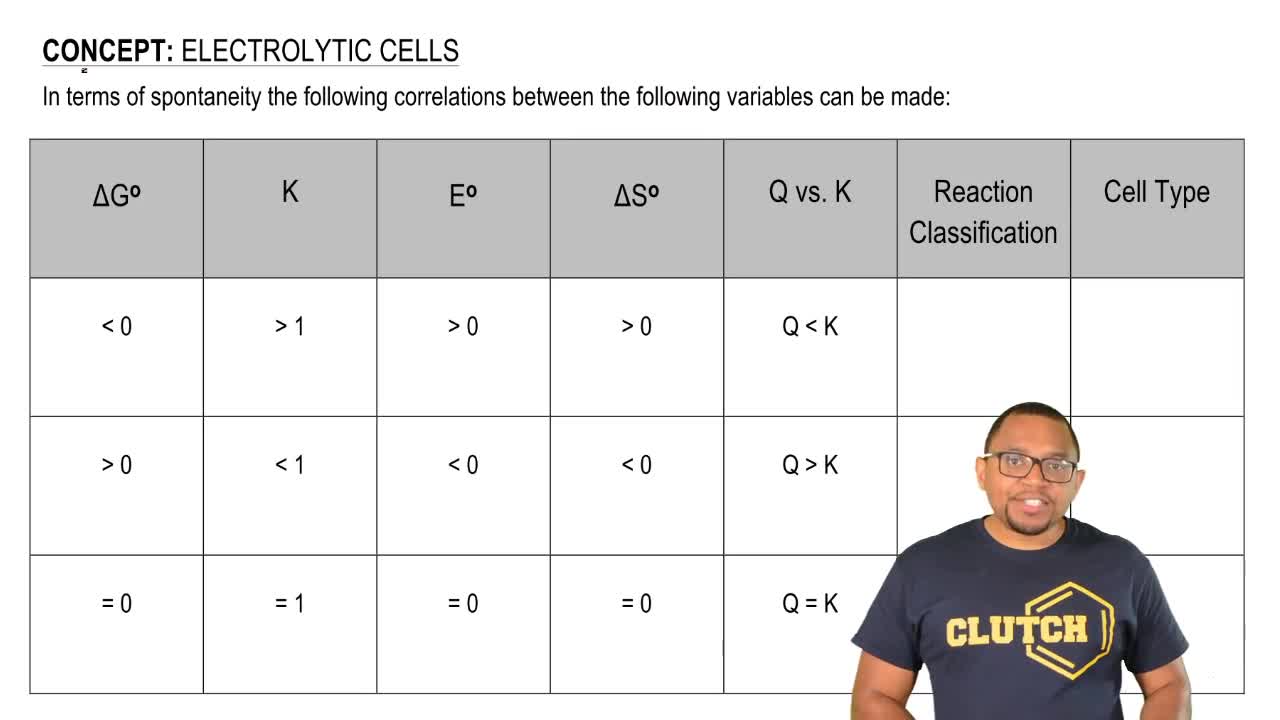
 06:11
06:11