Skip to main content
Analytical Chemistry
나의 코스
배우기
시험 준비
AI 튜터
학습 가이드
플래시카드
탐험해 보세요
앱을 사용해 보세요
나의 코스
배우기
시험 준비
AI 튜터
학습 가이드
플래시카드
탐험해 보세요
앱을 사용해 보세요
뒤로
EDTA definitions
카드를 뒤집기 위해 탭할 수 있습니다.
Hexaprotic Acid
카드를 뒤집기 위해 탭할 수 있습니다.
👆
Hexaprotic Acid
A molecule containing six acidic hydrogens, each capable of being lost as a proton depending on the solution's pH.
진행 상황 추적
컨트롤 버튼이 '내비게이션' 모드로 변경되었습니다.
1/15
관련 플래시카드
관련 실천
추천 영상
EDTA quiz
EDTA
15 용어
EDTA
11. EDTA Titrations
5 문제점
주제
EDTA Titration Curves
11. EDTA Titrations
5 문제점
주제
11. EDTA Titrations
3 주제
9 문제점
장
VideoThumbView.guidedCourse
05:31
EDTA Complexes
477
views
7
rank
VideoThumbView.guidedCourse
05:46
EDTA
1540
views
15
rank
1
comments
VideoThumbView.guidedCourse
03:26
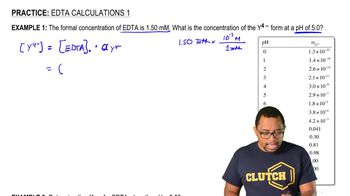
EDTA Calculations 1
554
views
8
rank
이 집합의 용어 (15)
하이드의 정의
Hexaprotic Acid
A molecule containing six acidic hydrogens, each capable of being lost as a proton depending on the solution's pH.
pKa
A numerical value indicating the acidity of a specific hydrogen atom, with lower values signifying stronger acidity.
Carboxyl Group
An acidic functional group in organic molecules, contributing to lower pKa values and higher acidity.
Amine Group
A basic functional group in organic molecules, associated with higher pKa values compared to carboxyl groups.
Deprotonation
The process where a proton is removed from a molecule, often influenced by the solution's pH relative to pKa.
Basic Form
The fully deprotonated state of a molecule, predominant at high pH and optimal for forming metal complexes.
Neutral Form
A molecular state with no net charge, often preferred for storage and transport in solution.
Metal Complex
A structure formed when a ligand binds to a metal ion, often stabilized by multiple donor atoms.
Formation Constant
An equilibrium constant quantifying the stability of a metal-ligand complex, with higher values indicating stronger binding.
Conditional Formation Constant
A modified equilibrium constant accounting for the fraction of ligand in its reactive form at a specific pH.
Ligand
A molecule or ion that donates electron pairs to a metal ion, forming a coordinate bond in a complex.
Equilibrium
A dynamic state where the rates of forward and reverse reactions are equal, resulting in constant concentrations.
Ionic Strength
A measure of the total concentration of ions in solution, affecting the stability of complexes.
Fractional Abundance
The proportion of a specific molecular form present in a mixture, often dependent on pH and pKa values.
Charge
The net electrical property of a molecule or ion, determined by the balance of protons and electrons.
 뒤로뒤로
뒤로뒤로
 05:31
05:31