Skip to main content
Analytical Chemistry
나의 코스
배우기
시험 준비
AI 튜터
학습 가이드
플래시카드
탐험해 보세요
앱을 사용해 보세요
나의 코스
배우기
시험 준비
AI 튜터
학습 가이드
플래시카드
탐험해 보세요
앱을 사용해 보세요
뒤로
Fractional Compositions and Concentrations quiz
카드를 뒤집기 위해 탭할 수 있습니다.
What happens to the fractional composition of a weak acid solution as pH decreases?
카드를 뒤집기 위해 탭할 수 있습니다.
👆
What happens to the fractional composition of a weak acid solution as pH decreases?
As pH decreases, the fraction of the acid form increases and the solution becomes more acidic.
진행 상황 추적
컨트롤 버튼이 '내비게이션' 모드로 변경되었습니다.
1/15
관련 플래시카드
관련 실천
추천 영상
Fractional Compositions and Concentrations definitions
Fractional Compositions and Concentrations
15 용어
Fractional Compositions and Concentrations
12. Advanced Topics in Equilibrium
5 문제점
주제
Dependence of Solubility on pH
12. Advanced Topics in Equilibrium
5 문제점
주제
12. Advanced Topics in Equilibrium
3 주제
9 문제점
장
VideoThumbView.guidedCourse
03:52
Fractional Composition
448
views
8
rank
VideoThumbView.guidedCourse
03:30
Fractional Concentrations
217
views
VideoThumbView.guidedCourse
04:51
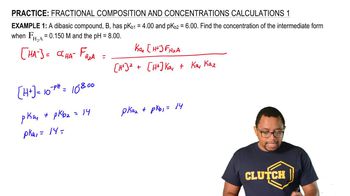
Fractional Concentrations Calculations 1
218
views
1
comments
이 집합의 용어 (15)
하이드의 정의
What happens to the fractional composition of a weak acid solution as pH decreases?
As pH decreases, the fraction of the acid form increases and the solution becomes more acidic.
At what pH are the concentrations of a weak acid and its conjugate base equal?
The concentrations are equal when pH equals the pKa of the acid.
Which equation describes the relationship between pH, pKa, and the ratio of conjugate base to acid?
The Henderson-Hasselbalch equation: pH = pKa + log([conjugate base]/[acid]).
How is the fraction of acid molecules (α) in a monoprotic system calculated?
It is calculated as [H+]/([H+] + Ka).
How is the fraction of conjugate base molecules (α_A-) in a monoprotic system calculated?
It is calculated as Ka/([H+] + Ka).
What is the sum of the fractions of acid and conjugate base forms in a monoprotic system?
The sum is always 1, representing 100% of the molecules present.
How does the fraction of conjugate base change as pH increases in a weak acid solution?
As pH increases, the fraction of conjugate base increases while the fraction of acid decreases.
What are the three possible forms in a diprotic acid system?
The three forms are the acidic form, the intermediate form, and the basic form.
What marks the intersection point between the acid and intermediate forms in a diprotic system?
The intersection occurs at pH = pKa1, where the concentrations of acid and intermediate forms are equal.
What marks the intersection point between the intermediate and basic forms in a diprotic system?
The intersection occurs at pH = pKa2, where the concentrations of intermediate and basic forms are equal.
How is the concentration of the intermediate form in a diprotic system calculated after losing the first acidic hydrogen?
It is calculated as the concentration of the acid form times Ka1 divided by [H+].
How is the concentration of the basic form in a diprotic system calculated after losing both acidic hydrogens?
It is calculated as the acid form concentration times Ka1 times Ka2 divided by [H+] squared.
What happens to the fraction of the basic form in a diprotic system as pH increases?
The fraction of the basic form increases as pH increases.
How can the actual concentrations of acid and conjugate base in a monoprotic system be determined?
Multiply the fraction of each form by the formal concentration of the solution.
What does a graphical representation of fractional composition versus pH show in both mono- and diprotic systems?
It shows how the proportions of different forms change with pH, with intersections at pKa values where concentrations of forms are equal.
 뒤로뒤로
뒤로뒤로
 03:52
03:52