Skip to main content
Analytical Chemistry
나의 코스
배우기
시험 준비
AI 튜터
학습 가이드
플래시카드
탐험해 보세요
앱을 사용해 보세요
나의 코스
배우기
시험 준비
AI 튜터
학습 가이드
플래시카드
탐험해 보세요
앱을 사용해 보세요
뒤로
Fundamentals of Electrolysis definitions
카드를 뒤집기 위해 탭할 수 있습니다.
Electrolysis
카드를 뒤집기 위해 탭할 수 있습니다.
👆
Electrolysis
Process using external electrical energy to induce chemical changes in a substance that would not occur naturally.
진행 상황 추적
컨트롤 버튼이 '내비게이션' 모드로 변경되었습니다.
1/15
관련 플래시카드
관련 실천
추천 영상
Fundamentals of Electrolysis quiz
Fundamentals of Electrolysis
15 용어
Fundamentals of Electrolysis
16. Electroanalytical Techniques
5 문제점
주제
Gravimetric Analysis
16. Electroanalytical Techniques
5 문제점
주제
16. Electroanalytical Techniques
4 주제
12 문제점
장
VideoThumbView.guidedCourse
03:14
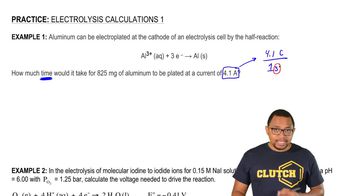
Electrolysis Calculations 1
378
views
1
rank
VideoThumbView.guidedCourse
02:50
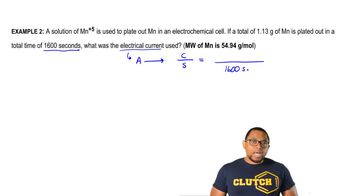
Fundamentals of Electrolysis Calculations 1
408
views
2
rank
VideoThumbView.guidedCourse
02:07
Electrolysis and Current Calculations 1
287
views
1
rank
이 집합의 용어 (15)
하이드의 정의
Electrolysis
Process using external electrical energy to induce chemical changes in a substance that would not occur naturally.
Non-spontaneous Process
Chemical change requiring outside energy input, as it does not proceed on its own under standard conditions.
Electrical Current
Flow of electric charge, measured in amperes, essential for driving reactions in electrolysis.
Ampere
Unit representing one coulomb of charge passing a point per second, used to quantify electrical current.
Coulomb
SI unit of electric charge, representing the quantity of electricity transported in one second by a current of one ampere.
Faraday's Constant
Value expressing the charge of one mole of electrons, crucial for calculating electron transfer in reactions.
Cell Potential
Electrical potential difference across electrodes, negative in non-spontaneous reactions requiring external energy.
Ohmic Potential
Voltage needed to overcome resistance in the circuit when current flows during electrolysis.
Overpotential
Extra voltage required to surpass activation energy barriers at electrodes, beyond theoretical cell potential.
Concentration Polarization
Difference in reactant concentration at the electrode surface compared to the bulk solution, affecting reaction efficiency.
Resistance
Opposition to current flow in a circuit, influencing the voltage required for electrolysis.
Activation Energy
Minimum energy needed to initiate a chemical reaction at the electrode during electrolysis.
Electrode
Conductive surface where oxidation or reduction occurs, facilitating electron transfer in electrolysis.
Bulk Solution
Main body of the solution, distinct from the region near the electrode, with relatively uniform composition.
Moles of Electrons
Quantity representing the total electrons transferred, calculated using current, time, and Faraday's constant.
 뒤로뒤로
뒤로뒤로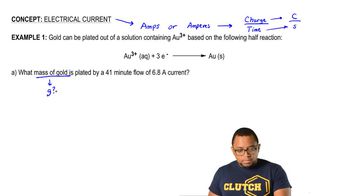
 03:14
03:14