Skip to main content
Analytical Chemistry
나의 코스
배우기
시험 준비
AI 튜터
학습 가이드
플래시카드
탐험해 보세요
앱을 사용해 보세요
나의 코스
배우기
시험 준비
AI 튜터
학습 가이드
플래시카드
탐험해 보세요
앱을 사용해 보세요
뒤로
Safety & Labels definitions
카드를 뒤집기 위해 탭할 수 있습니다.
OSHA
카드를 뒤집기 위해 탭할 수 있습니다.
👆
OSHA
A U.S. agency setting guidelines for safe chemical use, storage, and labeling in laboratories to prevent accidents and ensure worker safety.
진행 상황 추적
컨트롤 버튼이 '내비게이션' 모드로 변경되었습니다.
1/15
관련 플래시카드
관련 실천
추천 영상
Safety & Labels quiz
Safety & Labels
15 용어
Safety & Labels
2. Tools of the Trade
5 문제점
주제
Buoyancy
2. Tools of the Trade
5 문제점
주제
2. Tools of the Trade - Part 1 of 2
4 주제
11 문제점
장
2. Tools of the Trade - Part 2 of 2
1 주제
3 문제점
장
VideoThumbView.guidedCourse
05:13
Safety & Labels
354
views
3
rank
이 집합의 용어 (15)
하이드의 정의
OSHA
A U.S. agency setting guidelines for safe chemical use, storage, and labeling in laboratories to prevent accidents and ensure worker safety.
Health Hazard
A risk category, indicated by blue, assessing a substance's potential to cause harm through skin contact or inhalation.
Fire Hazard
A risk category, marked in red, evaluating a substance's likelihood to ignite based on its flash point temperature.
Instability Hazard
A risk category, shown in yellow, describing a substance's tendency to explode or react violently under certain conditions.
Specific Hazard
A label section, in white, using abbreviations to indicate unique dangers like acids, alkalis, oxidizers, or water reactivity.
Flash Point
The minimum temperature at which a chemical can vaporize to form an ignitable mixture in air, indicating fire risk.
Corrosive
A property of substances that can destroy or irreversibly damage other materials, including living tissue, upon contact.
Oxidizer
A substance that can release oxygen or another oxidizing substance, increasing the risk or intensity of combustion.
Polymerization
A chemical process where small molecules combine to form larger chains, sometimes causing hazardous reactions in certain chemicals.
Radioactivity
The emission of ionizing radiation or particles from unstable atomic nuclei, posing unique laboratory hazards.
Numerical Scale
A rating system from 0 (minimal risk) to 4 (extreme danger) used to quantify hazard severity on chemical labels.
Color-Coded System
A labeling method using distinct colors to quickly communicate the type of hazard a chemical presents.
Accuracy
The closeness of a measured value to the true value, essential for reliable and safe laboratory results.
Precision
The consistency of repeated measurements, crucial for reproducibility and safety in experimental procedures.
Water Reactivity
A property indicating that a substance can react violently or explosively when exposed to water.
 뒤로뒤로
뒤로뒤로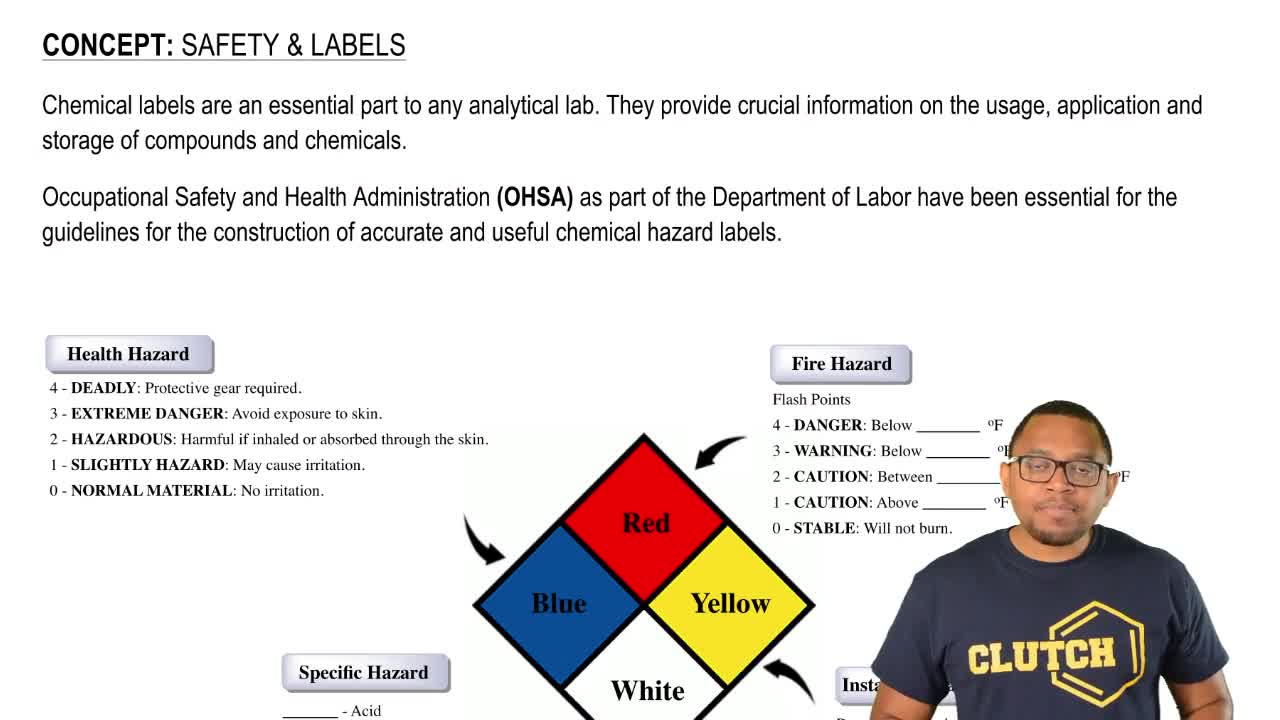
 05:13
05:13