Skip to main content
Analytical Chemistry
나의 코스
배우기
시험 준비
AI 튜터
학습 가이드
플래시카드
탐험해 보세요
앱을 사용해 보세요
나의 코스
배우기
시험 준비
AI 튜터
학습 가이드
플래시카드
탐험해 보세요
앱을 사용해 보세요
뒤로
Standard Potentials quiz
카드를 뒤집기 위해 탭할 수 있습니다.
What does voltage (e) represent in an electrochemical cell?
카드를 뒤집기 위해 탭할 수 있습니다.
👆
What does voltage (e) represent in an electrochemical cell?
Voltage represents the amount of work done as electrons move from one electrode to another.
진행 상황 추적
컨트롤 버튼이 '내비게이션' 모드로 변경되었습니다.
1/15
관련 플래시카드
관련 실천
추천 영상
Standard Potentials definitions
Standard Potentials
15 용어
Standard Potentials
13. Fundamentals of Electrochemistry
5 문제점
주제
Nernst Equation
13. Fundamentals of Electrochemistry
5 문제점
주제
13. Fundamentals of Electrochemistry - Part 1 of 2
4 주제
12 문제점
장
13. Fundamentals of Electrochemistry - Part 2 of 2
1 주제
3 문제점
장
VideoThumbView.guidedCourse
03:08
Standard Potential Calculations 1
287
views
2
rank
VideoThumbView.guidedCourse
03:59
Standard Potential
336
views
2
rank
VideoThumbView.guidedCourse
03:16
Standard Potential
307
views
3
rank
이 집합의 용어 (15)
하이드의 정의
What does voltage (e) represent in an electrochemical cell?
Voltage represents the amount of work done as electrons move from one electrode to another.
How is one volt defined in terms of units?
One volt is defined as joules per coulomb.
How are half reactions typically written in electrochemistry?
Half reactions are typically written as reductions, with electrons as reactants.
What happens to the oxidation number in a reduction half reaction?
The oxidation number decreases from reactant to product in a reduction half reaction.
What is the Standard Hydrogen Electrode (SHE) used for?
The SHE is used as a reference electrode to compare the potential of other half reactions.
What does a higher cell potential indicate about a half reaction?
A higher cell potential indicates a greater likelihood of reduction.
What does a smaller e value suggest about a half reaction?
A smaller e value suggests the reaction is more likely to undergo oxidation.
How can you determine which half reaction will be oxidized or reduced?
By comparing cell potentials, the reaction with the higher potential is more likely to be reduced, and the lower is more likely to be oxidized.
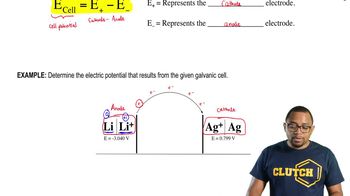
What is the formula for calculating the overall cell potential (E cell) when concentrations are 1 molar?
E cell = E+ (cathode) minus E- (anode).
What do E+ and E- represent in the cell potential equation?
E+ represents the cathode electrode, and E- represents the anode electrode.
When can the simple cell potential equation (E cell = E+ - E-) be used?
It can be used when ion concentrations are at 1 molar.
What equation must be used if ion concentrations are not 1 molar?
The Nernst equation must be used to determine the cell potential.
What assumption is made if concentrations are not given in a redox reaction problem?
We assume the concentrations are 1 molar (unity).
What is the significance of comparing cell potentials in a galvanic cell?
Comparing cell potentials helps determine which electrode acts as the cathode and which as the anode.
How do you calculate the overall cell potential for a galvanic cell using lithium and silver half reactions?
You subtract the anode potential from the cathode potential using their given cell potential values.
 뒤로뒤로
뒤로뒤로
 03:08
03:08