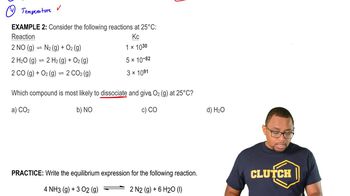
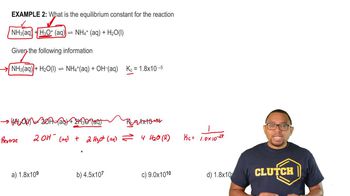
What does it mean when a chemical reaction does not go to completion?
It means that not all reactants are converted into products, and some reactants remain when equilibrium is reached.
What is chemical equilibrium?
Chemical equilibrium is the state where the rates of the forward and reverse reactions are equal, so the concentrations of reactants and products remain constant.
How is the equilibrium constant (K) related to the rate constants of a reaction?
The equilibrium constant K is equal to the rate constant of the forward reaction divided by the rate constant of the reverse reaction.
How do you write the equilibrium expression for a reaction?
The equilibrium expression is written as the concentration of products raised to their coefficients divided by the concentration of reactants raised to their coefficients, ignoring solids and liquids.
What does a K value greater than 1 indicate about a reaction?
A K value greater than 1 means the forward direction is favored and more products are formed at equilibrium.
What does a K value less than 1 indicate about a reaction?
A K value less than 1 means the reverse direction is favored and more reactants remain at equilibrium.
What does a K value equal to 1 indicate?
A K value equal to 1 means neither direction is favored and the concentrations of products and reactants are equal at equilibrium.
At the start of a reaction, which rate is present: forward or reverse?
At the start, only the forward rate is present because there are only reactants and no products yet.
Why does the forward rate decrease over time in a reaction?
The forward rate decreases because the concentration of reactants decreases as they are converted into products.
When does the reverse rate begin to increase in a reaction?
The reverse rate increases as products accumulate and begin to convert back into reactants.
How can equilibrium be visually identified on a concentration vs. time graph?
Equilibrium is reached when the concentrations of reactants and products plateau and stop changing over time.
What is ignored when writing the equilibrium expression?
Solids and liquids are ignored when writing the equilibrium expression.
What happens to the rates of the forward and reverse reactions at equilibrium?
At equilibrium, the rates of the forward and reverse reactions are equal.
How can the value of K help predict the outcome of a reaction?
The value of K indicates whether products or reactants are favored at equilibrium, helping predict the direction the reaction will proceed.
What must happen before equilibrium can be established in a chemical reaction?
Equilibrium can only be established once the rates of the forward and reverse reactions become equal.
 뒤로
뒤로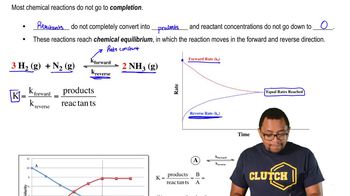
 06:33
06:33