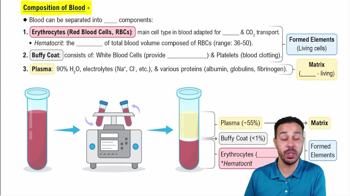
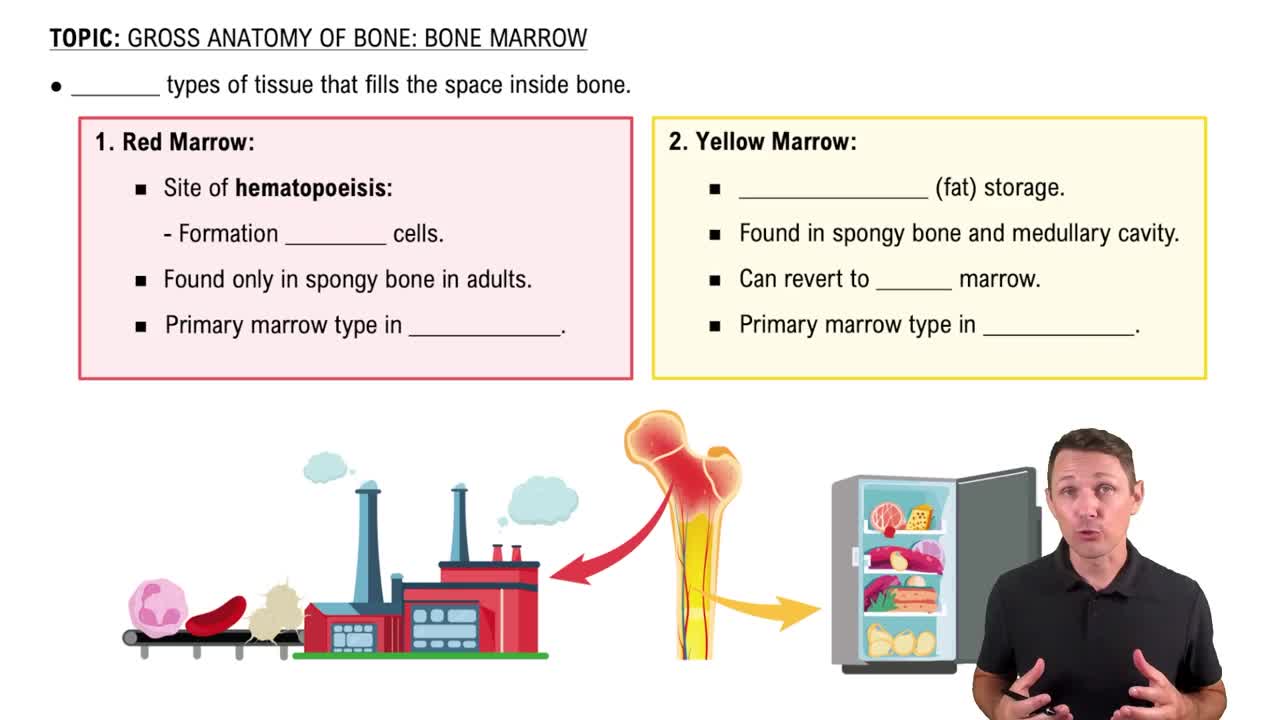
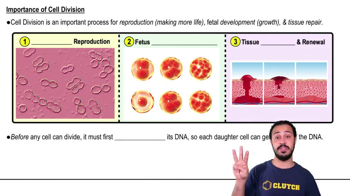
Red blood cells, which carry oxygen to body tissues, live for only about 120 days. Replacement cells are produced by cell division in bone marrow. How many cell divisions must occur each second in your bone marrow just to replace red blood cells? Here is some information to use in calculating your answer: There are about 5 million red blood cells per cubic millimeter (mm3) of blood. An average adult has about 5 L (5,000 cm3) of blood. (Hint: What is the total number of red blood cells in the body? What fraction of them must be replaced each day if all are replaced in 120 days?)
검증된 단계별 안내
1
Calculate the total number of red blood cells in the body by multiplying the number of red blood cells per cubic millimeter by the total volume of blood in cubic millimeters. Use the conversion that 1 cm3 equals 1,000 mm3.
Determine the fraction of red blood cells that need to be replaced each day by dividing the total lifespan of a red blood cell (120 days) into 1.
Multiply the total number of red blood cells by the fraction calculated in step 2 to find out how many red blood cells need to be replaced each day.
Convert the daily replacement requirement to a per second basis by dividing the number of cells that need to be replaced daily by the number of seconds in a day (86,400 seconds).
The result from step 4 gives you the number of cell divisions per second that must occur in the bone marrow to maintain the red blood cell count.
Verified video answer for a similar problem:
This video solution was recommended by our tutors as helpful for the problem above
영상 길이:
1m
영상 재생:
0 댓글
TextbookSolutions.keyConceptsTitle
TextbookSolutions.keyConceptsSubtitle
Red Blood Cell Lifespan
Red blood cells (RBCs) have a lifespan of approximately 120 days, after which they are removed from circulation and replaced. Understanding this lifespan is crucial for calculating the rate of RBC replacement in the body, as it determines how many cells need to be produced daily to maintain adequate oxygen transport.
Bone marrow is the primary site of hematopoiesis, the process of blood cell production, including red blood cells. It is essential to understand how bone marrow functions to appreciate how it compensates for the loss of RBCs, as it must continuously divide and produce new cells to meet the body's oxygen demands.
To determine how many cell divisions occur each second in the bone marrow, one must calculate the total number of RBCs in the body and the daily replacement rate. This involves understanding the volume of blood, the concentration of RBCs, and the time frame for replacement, allowing for the calculation of the necessary cell division rate to sustain RBC levels.