Electrons .
a. are negatively charged;
b. along with neutrons make up the nucleus;
c. are attracted to the negatively charged nucleus;
d. are not involved in ionic bonds;
e. all of the above are true
검증된 단계별 안내
1
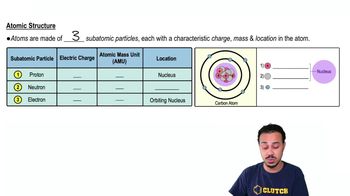
Step 1: Understand the basic properties of electrons. Electrons are subatomic particles with a negative charge.
Step 2: Analyze option (a). Electrons are indeed negatively charged, which is a fundamental property of electrons.
Step 3: Evaluate option (b). The nucleus of an atom is composed of protons and neutrons, not electrons. Electrons orbit the nucleus.
Step 4: Consider option (c). The nucleus is positively charged due to protons, so electrons are attracted to it, not repelled.
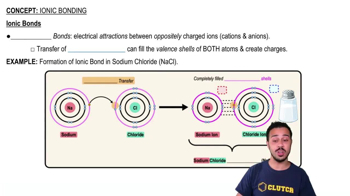
Step 5: Examine option (d). Electrons are involved in ionic bonds, as they are transferred between atoms to form ions.
비슷한 문제에 대한 검증된 영상 답변:
이 영상 해법은 위 문제에 도움이 된다고 튜터들이 추천한 것입니다.
영상 길이:
46s
영상 재생:
0 댓글
주요 개념
질문에 올바르게 답하기 위해 반드시 이해해야 하는 핵심 개념들은 다음과 같습니다.
Charge of Electrons
Electrons are subatomic particles that carry a negative electric charge. This charge is fundamental to their behavior in atoms and influences how they interact with other charged particles, such as protons, which are positively charged.
An atom consists of a nucleus made up of protons and neutrons, with electrons orbiting around it. Neutrons are neutral and do not affect the charge, while protons contribute to the positive charge of the nucleus, creating an attractive force that holds electrons in their orbits.
Ionic bonds are formed when electrons are transferred from one atom to another, resulting in the formation of charged ions. Electrons play a crucial role in this process, as they are the particles that are lost or gained, leading to the attraction between oppositely charged ions.

 0:46분
0:46분 검증된 단계별 안내
 07:41
07:41