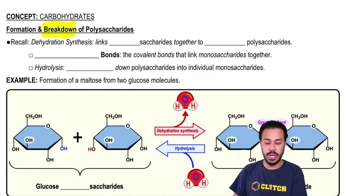
Add labels to the figure that follows, which illustrates the breakdown of a disaccharide inside a cell.
검증된 단계별 안내
1
Identify the disaccharide structure at the top of the image, which consists of two hexagonal rings representing monosaccharides linked together.
Recognize the arrow pointing from the disaccharide to the green structure, indicating the process of breakdown or hydrolysis.
Label the disaccharide structure as 'Disaccharide' or 'Substrate', which is the molecule being broken down.
Label the green structure as 'Enzyme', which facilitates the breakdown of the disaccharide into monosaccharides.
Label the resulting monosaccharides after the breakdown, which are the products of the enzymatic reaction.
비슷한 문제에 대한 검증된 영상 답변:
이 영상 해법은 위 문제에 도움이 된다고 튜터들이 추천한 것입니다.
영상 길이:
2m
영상 재생:
0 댓글
주요 개념
질문에 올바르게 답하기 위해 반드시 이해해야 하는 핵심 개념들은 다음과 같습니다.
Disaccharides
Disaccharides are carbohydrates formed by the combination of two monosaccharides through a glycosidic bond. Common examples include sucrose (glucose + fructose) and lactose (glucose + galactose). Understanding their structure and function is crucial for analyzing how they are broken down in cellular processes.
A glycosidic bond is a type of covalent bond that links monosaccharides together to form disaccharides and polysaccharides. This bond is formed through a dehydration reaction, where a water molecule is released. Recognizing how these bonds are formed and broken is essential for understanding carbohydrate metabolism.
Cellular metabolism encompasses all biochemical reactions occurring within a cell, including the breakdown of carbohydrates like disaccharides. This process involves enzymes that catalyze the hydrolysis of glycosidic bonds, releasing energy and simpler sugars for cellular use. A grasp of metabolic pathways is vital for comprehending how cells utilize nutrients.

 2:16분
2:16분
 검증된 단계별 안내
 03:08
03:08