How do the phospholipids in archaea differ from those in other cells?
a. They have tails made of unsaturated fatty acids instead of saturated fatty acids.
b. They do not contain hydrocarbon chains.
c. They have isoprenoid tails instead of fatty acid tails.
d. They have two hydrocarbon chains instead of three hydrocarbon chains.
검증된 단계별 안내
1
Step 1: Understand the structure of phospholipids. Phospholipids are a type of lipid molecule that is the main component of the cell membrane. They are composed of two fatty acid tails and a phosphate group head.
Step 2: Recognize that the structure of phospholipids can vary between different types of cells. In particular, the structure of phospholipids in archaea, a type of single-celled microorganism, differs from those in other cells.
Step 3: Evaluate each of the given options. Option a suggests that archaeal phospholipids have tails made of unsaturated fatty acids instead of saturated fatty acids. Option b suggests that they do not contain hydrocarbon chains. Option c suggests that they have isoprenoid tails instead of fatty acid tails. Option d suggests that they have two hydrocarbon chains instead of three.
Step 4: Recall that the key difference between archaeal phospholipids and those in other cells is in the nature of their tails. Archaeal phospholipids have isoprenoid tails, which are made up of repeating five-carbon units, instead of the fatty acid tails found in other cells.
Step 5: Based on this information, the correct answer is option c: They have isoprenoid tails instead of fatty acid tails.
비슷한 문제에 대한 검증된 영상 답변:
이 영상 해법은 위 문제에 도움이 된다고 튜터들이 추천한 것입니다.
영상 길이:
1m
영상 재생:
0 댓글
주요 개념
질문에 올바르게 답하기 위해 반드시 이해해야 하는 핵심 개념들은 다음과 같습니다.
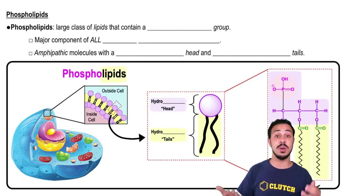
Phospholipid Structure
Phospholipids are molecules that form the fundamental structure of cell membranes, consisting of a hydrophilic (water-attracting) 'head' and hydrophobic (water-repelling) 'tails.' In archaea, the tails can differ significantly from those in bacteria and eukaryotes, influencing membrane fluidity and stability.
In archaea, phospholipids often feature isoprenoid tails, which are branched hydrocarbons derived from isoprene units. This contrasts with the straight-chain fatty acids found in the phospholipids of bacteria and eukaryotes, providing archaea with unique membrane properties that enhance their survival in extreme environments.
The composition of cell membranes, including the types of phospholipids present, is crucial for maintaining cellular integrity and function. In archaea, the unique structure of their phospholipids contributes to their ability to thrive in extreme conditions, such as high temperatures and salinity, by providing greater membrane stability.

 1:48분
1:48분 검증된 단계별 안내
 04:05
04:05