Describe the process of DNA replication: the ingredients needed, the steps in the process, and the final product.
검증된 단계별 안내
1
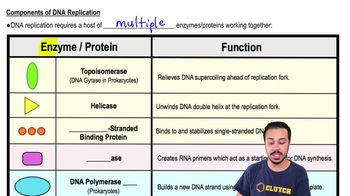
Identify the ingredients needed for DNA replication: DNA template, nucleotides (A, T, C, G), DNA polymerase, helicase, primase, and ligase.
Initiate the process by unwinding the DNA double helix using the enzyme helicase, creating two single strands that serve as templates.
Synthesize a short RNA primer on each template strand using the enzyme primase, providing a starting point for DNA polymerase.
Elongate the new DNA strand by adding complementary nucleotides to the template strand, facilitated by DNA polymerase, in the 5' to 3' direction.
Join Okazaki fragments on the lagging strand using DNA ligase to create a continuous DNA strand, resulting in two identical DNA molecules.
비슷한 문제에 대한 검증된 영상 답변:
이 영상 해법은 위 문제에 도움이 된다고 튜터들이 추천한 것입니다.
영상 길이:
2m
영상 재생:
0 댓글
주요 개념
질문에 올바르게 답하기 위해 반드시 이해해야 하는 핵심 개념들은 다음과 같습니다.
DNA Structure
DNA, or deoxyribonucleic acid, is a double helix composed of nucleotides, which include a phosphate group, a sugar (deoxyribose), and nitrogenous bases (adenine, thymine, cytosine, and guanine). The specific pairing of bases (A with T and C with G) is crucial for accurate replication. Understanding this structure is essential for grasping how DNA is copied during replication.
Several key enzymes facilitate DNA replication, including helicase, which unwinds the DNA double helix, and DNA polymerase, which synthesizes new DNA strands by adding nucleotides complementary to the template strand. Other enzymes, like primase and ligase, play roles in starting the replication process and joining Okazaki fragments on the lagging strand, respectively.
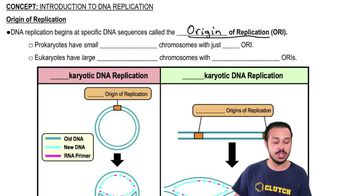
DNA replication occurs in several steps: initiation, elongation, and termination. During initiation, the DNA unwinds and separates at the origin of replication. In elongation, DNA polymerase adds nucleotides to form new strands, resulting in two identical DNA molecules. Finally, termination occurs when replication is complete, ensuring that each new DNA molecule consists of one original and one newly synthesized strand, a process known as semi-conservative replication.

 2:27분
2:27분 검증된 단계별 안내
 03:20
03:20