Circle and name the functional groups in this organic molecule. What type of compound is this? For which class of macromolecules is it a monomer?
검증된 단계별 안내
1
Identify and circle the amine group (-NH2) in the molecule. This group consists of a nitrogen atom bonded to two hydrogen atoms.
Identify and circle the carboxyl group (-COOH) in the molecule. This group consists of a carbon atom double-bonded to an oxygen atom and single-bonded to a hydroxyl group (-OH).
Identify and circle the hydroxyl group (-OH) attached to the CH2 group in the molecule.
Determine the type of compound by recognizing the functional groups present. The presence of both an amine group and a carboxyl group indicates that this is an amino acid.
Classify the molecule as a monomer for proteins, as amino acids are the building blocks of proteins.
비슷한 문제에 대한 검증된 영상 답변:
이 영상 해법은 위 문제에 도움이 된다고 튜터들이 추천한 것입니다.
영상 길이:
1m
영상 재생:
0 댓글
주요 개념
질문에 올바르게 답하기 위해 반드시 이해해야 하는 핵심 개념들은 다음과 같습니다.
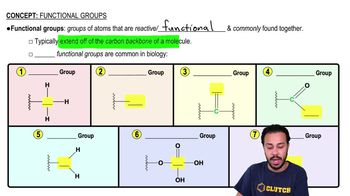
Functional Groups
Functional groups are specific groups of atoms within molecules that are responsible for the characteristic chemical reactions of those molecules. In organic chemistry, common functional groups include hydroxyl (-OH), carboxyl (-COOH), amino (-NH2), and others. Identifying these groups helps in understanding the properties and reactivity of the compound.
Organic compounds are categorized based on their functional groups and structure. The molecule in the image contains both amino and hydroxyl groups, indicating it is likely an amino acid. Amino acids are the building blocks of proteins, which are essential macromolecules in biological systems.
Macromolecules are large, complex molecules essential for life, including proteins, nucleic acids, carbohydrates, and lipids. Monomers are the smaller units that combine to form these macromolecules. In this case, the molecule is a monomer (an amino acid) that links together to form proteins, which are crucial for various biological functions.

 1:06분
1:06분
 검증된 단계별 안내
 06:04
06:04