DRAW IT Draw the hydration shells that form around a potassium ion and a chloride ion when potassium chloride (KCl) dissolves in water. Label the positive, negative, and partial charges on the atoms.
검증된 단계별 안내
1
Identify the ions formed when potassium chloride (KCl) dissolves in water: KCl dissociates into K^+ (potassium ion) and Cl^- (chloride ion).
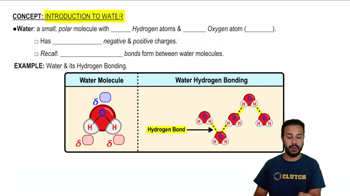
Understand the concept of hydration shells: When ions dissolve in water, they are surrounded by water molecules, forming hydration shells. Water is a polar molecule with a partial negative charge on the oxygen atom and a partial positive charge on the hydrogen atoms.
Draw the hydration shell around the potassium ion (K^+): Since K^+ is positively charged, the oxygen atoms of water molecules, which have a partial negative charge, will orient themselves towards the potassium ion.
Draw the hydration shell around the chloride ion (Cl^-): Since Cl^- is negatively charged, the hydrogen atoms of water molecules, which have a partial positive charge, will orient themselves towards the chloride ion.
Label the charges: Indicate the positive charge on the potassium ion, the negative charge on the chloride ion, and the partial charges on the water molecules (partial negative on oxygen and partial positive on hydrogen).
비슷한 문제에 대한 검증된 영상 답변:
이 영상 해법은 위 문제에 도움이 된다고 튜터들이 추천한 것입니다.
영상 길이:
1m
영상 재생:
0 댓글
주요 개념
질문에 올바르게 답하기 위해 반드시 이해해야 하는 핵심 개념들은 다음과 같습니다.
Hydration Shells
Hydration shells are layers of water molecules that surround ions when they dissolve in water. The polar nature of water molecules allows them to interact with charged ions, forming a structured arrangement where the oxygen atoms (partially negative) orient towards cations, while the hydrogen atoms (partially positive) face anions. This interaction stabilizes the ions in solution and is crucial for understanding solubility and ionic interactions in aqueous environments.
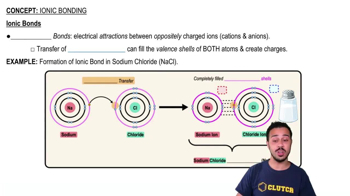
Ionic compounds, such as potassium chloride (KCl), consist of positively charged cations and negatively charged anions held together by electrostatic forces. When dissolved in water, these compounds dissociate into their constituent ions, allowing them to interact with water molecules. Understanding the nature of ionic bonds and the behavior of ions in solution is essential for visualizing the formation of hydration shells.
Water is a polar molecule, meaning it has a partial positive charge on one side (due to hydrogen atoms) and a partial negative charge on the other side (due to the oxygen atom). This polarity enables water to effectively interact with and stabilize ions in solution, leading to the formation of hydration shells. Recognizing the significance of water's polarity is fundamental for understanding how it facilitates the dissolution of ionic compounds.

 1:53분
1:53분 검증된 단계별 안내
 09:44
09:44