What is the oxidizing agent in the following reaction?
Pyruvate+NADH+H+→Lactate+NAD+
a. oxygen
b. NADH
c. lactate
d. pyruvate
검증된 단계별 안내
1
Identify the role of each component in the reaction: Pyruvate, NADH, H+, Lactate, and NAD+.
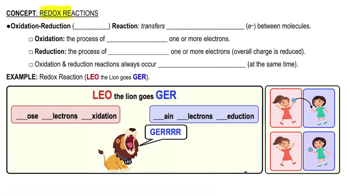
Understand that an oxidizing agent is a substance that gains electrons in a chemical reaction.
Recognize that in this reaction, NADH is being converted to NAD+, indicating it is losing electrons.
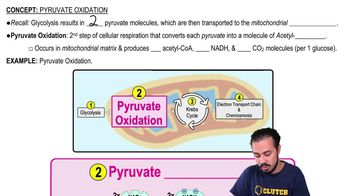
Determine which component is gaining electrons. Pyruvate is being converted to Lactate, suggesting it is gaining electrons.
Conclude that the substance gaining electrons (Pyruvate) is the oxidizing agent.
비슷한 문제에 대한 검증된 영상 답변:
이 영상 해법은 위 문제에 도움이 된다고 튜터들이 추천한 것입니다.
영상 길이:
1m
영상 재생:
0 댓글
주요 개념
질문에 올바르게 답하기 위해 반드시 이해해야 하는 핵심 개념들은 다음과 같습니다.
Oxidizing Agent
An oxidizing agent is a substance that gains electrons in a chemical reaction, causing another substance to be oxidized. In redox reactions, the oxidizing agent is reduced while facilitating the oxidation of another reactant. Identifying the oxidizing agent is crucial for understanding electron transfer processes in biochemical reactions.
Redox reactions, short for reduction-oxidation reactions, involve the transfer of electrons between two species. One species is oxidized (loses electrons) while the other is reduced (gains electrons). In the context of cellular metabolism, these reactions are vital for energy production and are often coupled with metabolic pathways like glycolysis and fermentation.
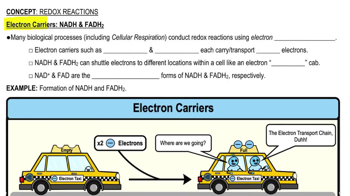
NADH (nicotinamide adenine dinucleotide) is a reduced form of NAD+, a coenzyme involved in redox reactions. NADH acts as an electron donor, while NAD+ serves as an electron acceptor. In the given reaction, the conversion of pyruvate to lactate involves the reduction of NAD+ to NADH, highlighting the role of these coenzymes in metabolic processes.

 1:11분
1:11분 검증된 단계별 안내
 04:38
04:38