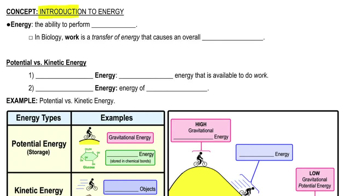
Which of the following correctly describe an exergonic reaction? Select True or False for each statement.
T/F The products have lower Gibbs free energy than the reactants.
T/F Activation energy is required for the reaction to proceed.
T/F The products always have lower entropy than the reactants.
T/F The reaction always occurs quickly.
검증된 단계별 안내
1
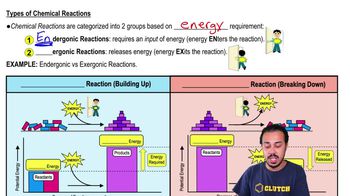
Understand that an exergonic reaction is one where energy is released, and the change in Gibbs free energy (ΔG) is negative.
Evaluate the first statement: 'The products have lower Gibbs free energy than the reactants.' In an exergonic reaction, this is true because ΔG is negative.
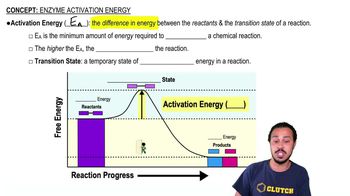
Consider the second statement: 'Activation energy is required for the reaction to proceed.' Even exergonic reactions require some initial energy input to overcome the activation energy barrier, so this is true.
Analyze the third statement: 'The products always have lower entropy than the reactants.' In exergonic reactions, entropy can increase or decrease, so this statement is false.
Examine the fourth statement: 'The reaction always occurs quickly.' The speed of a reaction is not determined by whether it is exergonic or endergonic, so this statement is false.
비슷한 문제에 대한 검증된 영상 답변:
이 영상 해법은 위 문제에 도움이 된다고 튜터들이 추천한 것입니다.
영상 길이:
2m
영상 재생:
0 댓글
주요 개념
질문에 올바르게 답하기 위해 반드시 이해해야 하는 핵심 개념들은 다음과 같습니다.
Exergonic Reaction
An exergonic reaction is a chemical process that releases energy, typically in the form of Gibbs free energy. In these reactions, the products have lower Gibbs free energy than the reactants, indicating that the reaction can occur spontaneously. This concept is crucial for understanding thermodynamics in biochemical processes.
Gibbs free energy (G) is a thermodynamic potential that measures the maximum reversible work obtainable from a thermodynamic system at constant temperature and pressure. A negative change in Gibbs free energy (ΔG < 0) indicates that a reaction is exergonic and can occur spontaneously, while a positive change (ΔG > 0) suggests that the reaction is non-spontaneous.
Activation energy is the minimum energy required for a chemical reaction to occur. Even in exergonic reactions, activation energy is necessary to initiate the reaction, as it helps to overcome the energy barrier for the reactants to transform into products. This concept highlights that not all spontaneous reactions occur rapidly; they may still require a significant energy input to start.

 2:31분
2:31분 검증된 단계별 안내
 05:48
05:48