If an enzyme is added to a solution where its substrate and product are in equilibrium, what will occur?
a. Additional substrate will be formed.
b. The reaction will change from endergonic to exergonic.
c. The free energy of the system will change.
d. Nothing; the reaction will stay at equilibrium.
검증된 단계별 안내
1
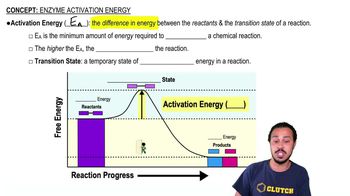
Understand the role of enzymes: Enzymes are biological catalysts that speed up the rate of a reaction without being consumed in the process. They do this by lowering the activation energy required for the reaction to proceed.
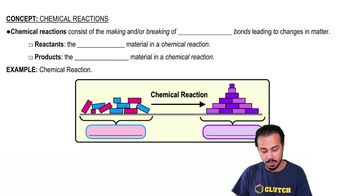
Consider the concept of equilibrium: In a chemical reaction at equilibrium, the rate of the forward reaction equals the rate of the reverse reaction, and the concentrations of reactants and products remain constant over time.
Analyze the effect of adding an enzyme: Adding an enzyme to a reaction at equilibrium does not change the equilibrium position. It accelerates both the forward and reverse reactions equally, maintaining the equilibrium state.
Evaluate the options: Since the enzyme does not alter the equilibrium position, it will not lead to the formation of additional substrate (option a), change the reaction from endergonic to exergonic (option b), or alter the free energy of the system (option c).
Conclude with the correct choice: Given that the enzyme does not affect the equilibrium state, the correct answer is that nothing will change; the reaction will stay at equilibrium (option d).
비슷한 문제에 대한 검증된 영상 답변:
이 영상 해법은 위 문제에 도움이 된다고 튜터들이 추천한 것입니다.
영상 길이:
53s
영상 재생:
0 댓글
주요 개념
질문에 올바르게 답하기 위해 반드시 이해해야 하는 핵심 개념들은 다음과 같습니다.
Enzyme Function
Enzymes are biological catalysts that speed up chemical reactions by lowering the activation energy required for the reaction to proceed. They do not change the equilibrium position of a reaction but can help reach equilibrium faster. Understanding how enzymes interact with substrates is crucial for predicting the outcome of adding an enzyme to a system.
In a chemical reaction at equilibrium, the rates of the forward and reverse reactions are equal, resulting in constant concentrations of reactants and products. Adding an enzyme does not alter the concentrations of substrates or products at equilibrium; it only affects the rate at which equilibrium is achieved. This concept is essential for understanding why certain options in the question may be incorrect.
Free energy (Gibbs free energy) determines the spontaneity of a reaction. A reaction is exergonic if it releases energy and is spontaneous, while an endergonic reaction requires energy input. When a system is at equilibrium, the free energy change (ΔG) is zero, meaning that adding an enzyme will not change the free energy of the system, which is key to answering the question.

 0:53분
0:53분 검증된 단계별 안내
 02:32
02:32