For a short time in the 1930s, some physicians prescribed low doses of a compound called dinitrophenol (DNP) to help patients lose weight. This unsafe method was abandoned after some patients died. DNP uncouples the chemiosmotic machinery by making the inner mitochondrial membrane leaky to H+. Explain how this drug could cause profuse sweating, weight loss, and possibly death.
검증된 단계별 안내
1
Understand that DNP disrupts the normal function of the mitochondria by making the inner mitochondrial membrane permeable to protons (H+).
Recognize that this disruption prevents the establishment of a proton gradient across the membrane, which is essential for ATP synthesis via oxidative phosphorylation.
Realize that without an effective proton gradient, the energy from electron transport is released as heat instead of being used to produce ATP, leading to increased body temperature and profuse sweating.
Acknowledge that the body attempts to compensate for the lack of ATP by increasing metabolic rate, which can lead to rapid weight loss as the body consumes more energy stores.
Understand that excessive heat production and energy depletion can overwhelm the body's homeostatic mechanisms, potentially leading to hyperthermia and death.
비슷한 문제에 대한 검증된 영상 답변:
이 영상 해법은 위 문제에 도움이 된다고 튜터들이 추천한 것입니다.
영상 길이:
1m
영상 재생:
0 댓글
주요 개념
질문에 올바르게 답하기 위해 반드시 이해해야 하는 핵심 개념들은 다음과 같습니다.
Chemiosmosis
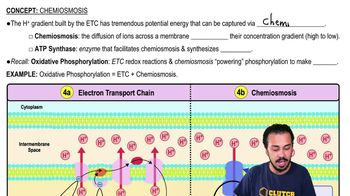
Chemiosmosis is the process by which ATP (adenosine triphosphate) is produced in cells through the movement of protons (H+) across a membrane. In mitochondria, this occurs when protons are pumped into the intermembrane space, creating a gradient that drives ATP synthesis as protons flow back into the mitochondrial matrix. DNP disrupts this process by making the inner mitochondrial membrane permeable to protons, preventing efficient ATP production.
Thermogenesis refers to the process of heat production in organisms, particularly in response to energy expenditure. When DNP uncouples oxidative phosphorylation, the energy that would normally be used to produce ATP is released as heat instead. This results in increased body temperature and profuse sweating as the body attempts to dissipate the excess heat, contributing to weight loss through elevated metabolic rates.
Toxicity and Metabolic Disruption
The use of DNP can lead to severe toxicity due to its ability to disrupt normal metabolic processes. By uncoupling oxidative phosphorylation, DNP causes cells to burn through energy reserves rapidly, leading to a state of hypermetabolism. This can result in dangerous side effects, including hyperthermia, dehydration, and ultimately, death, as the body cannot maintain homeostasis under such extreme conditions.

 1:38분
1:38분 검증된 단계별 안내
 05:01
05:01