A fat molecule consists of .
a. carbohydrates and proteins;
b. complex carbohydrates only;
c. saturated oxygen atoms;
d. a carbon skeleton and fatty acids
검증된 단계별 안내
1
Step 1: Understand the composition of a fat molecule, which is also known as a triglyceride.
Step 2: Recall that a triglyceride is composed of a glycerol backbone and three fatty acid chains.
Step 3: Recognize that the glycerol backbone is a carbon skeleton, which is a chain of carbon atoms.
Step 4: Identify that the fatty acids are long chains of carbon and hydrogen atoms, which attach to the glycerol backbone.
Step 5: Conclude that the correct components of a fat molecule are a carbon skeleton and fatty acids.
비슷한 문제에 대한 검증된 영상 답변:
이 영상 해법은 위 문제에 도움이 된다고 튜터들이 추천한 것입니다.
영상 길이:
2m
영상 재생:
0 댓글
주요 개념
질문에 올바르게 답하기 위해 반드시 이해해야 하는 핵심 개념들은 다음과 같습니다.
Fat Molecule Structure
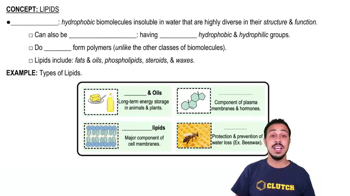
Fat molecules, also known as lipids, primarily consist of a carbon skeleton and fatty acids. The carbon skeleton forms the backbone of the molecule, while fatty acids are long hydrocarbon chains that can be saturated or unsaturated, influencing the fat's properties and functions in biological systems.
Fatty acids can be classified as saturated or unsaturated based on their chemical structure. Saturated fatty acids contain no double bonds between carbon atoms, making them solid at room temperature, while unsaturated fatty acids have one or more double bonds, resulting in a liquid state. This distinction is crucial for understanding the health implications of different types of fats.
Lipids, including fats, play essential roles in biological systems, such as energy storage, cellular structure, and signaling. They are a key component of cell membranes, providing fluidity and integrity, and serve as a concentrated energy source, making them vital for metabolic processes.

 2:44분
2:44분 검증된 단계별 안내
 7:17
7:17