Enzymes that break down DNA catalyze the hydrolysis of the covalent bonds that join nucleotides together. What would happen to DNA molecules treated with these enzymes?
a. The two strands of the double helix would separate.
b. The phosphodiester linkages of the polynucleotide backbone would be broken.
c. The pyrimidines would be separated from the deoxyribose sugars.
d. All bases would be separated from the deoxyribose sugars.
검증된 단계별 안내
1
Understand the role of enzymes that break down DNA: These enzymes, known as DNases, specifically catalyze the hydrolysis of the covalent bonds in DNA.
Identify the type of bonds targeted by these enzymes: DNases hydrolyze the phosphodiester bonds within the DNA molecule.
Analyze the structure of DNA: DNA is composed of a double helix structure with two strands linked by hydrogen bonds and each strand consisting of a sugar-phosphate backbone and nitrogenous bases attached to the sugar.
Determine the effect of breaking phosphodiester bonds: Hydrolyzing these bonds affects the integrity of the sugar-phosphate backbone, which holds the nucleotides together in a single strand.
Conclude the immediate structural change in DNA when treated with these enzymes: The breaking of phosphodiester bonds would lead to the fragmentation of the DNA strands into smaller pieces or individual nucleotides, but would not directly affect the hydrogen bonds between the strands or the attachment of bases to the sugars.
비슷한 문제에 대한 검증된 영상 답변:
이 영상 해법은 위 문제에 도움이 된다고 튜터들이 추천한 것입니다.
영상 길이:
27s
영상 재생:
0 댓글
주요 개념
질문에 올바르게 답하기 위해 반드시 이해해야 하는 핵심 개념들은 다음과 같습니다.
Enzyme Function
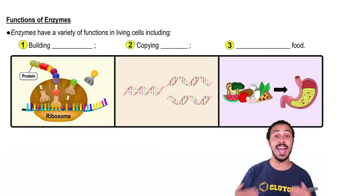
Enzymes are biological catalysts that speed up chemical reactions by lowering the activation energy required. In the context of DNA, specific enzymes, such as nucleases, facilitate the breakdown of DNA by catalyzing the hydrolysis of covalent bonds between nucleotides, leading to the degradation of the DNA structure.
DNA is composed of nucleotides linked together by covalent bonds known as phosphodiester linkages. These bonds connect the phosphate group of one nucleotide to the sugar of the next, forming the backbone of the DNA strand. Hydrolysis of these bonds results in the fragmentation of the DNA molecule.
The double helix structure of DNA consists of two strands that are complementary and anti-parallel. The stability of this structure relies on both hydrogen bonds between the nitrogenous bases and the covalent phosphodiester linkages in the backbone. When enzymes break these linkages, the strands can separate, leading to the loss of the double helix configuration.