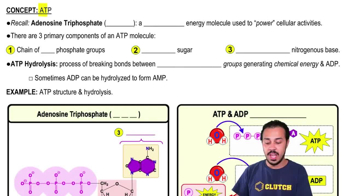
The synthesis of ATP from ADP and
a. stores energy in a form that can drive cellular work.
b. involves the hydrolysis of a phosphate bond.
c. transfers a phosphate, priming a protein to do work.
d. is an exergonic process.
검증된 단계별 안내
1
Identify the process being described: the synthesis of ATP from ADP.
Recall that ATP (adenosine triphosphate) is the primary energy carrier in cells.
Understand that the synthesis of ATP from ADP (adenosine diphosphate) involves the addition of a phosphate group.
Recognize that this process stores energy in the newly formed phosphate bond, which can be used for cellular work.
Determine which option correctly describes the synthesis of ATP: storing energy, not hydrolysis or exergonic processes.
비슷한 문제에 대한 검증된 영상 답변:
이 영상 해법은 위 문제에 도움이 된다고 튜터들이 추천한 것입니다.
영상 길이:
5m
영상 재생:
0 댓글
주요 개념
질문에 올바르게 답하기 위해 반드시 이해해야 하는 핵심 개념들은 다음과 같습니다.
ATP Synthesis
ATP synthesis refers to the process of forming adenosine triphosphate (ATP) from adenosine diphosphate (ADP) and inorganic phosphate (Pi). This process is crucial for storing energy in cells, as ATP serves as the primary energy currency, enabling various cellular functions and activities.
The hydrolysis of a phosphate bond involves the breaking of a high-energy bond in ATP, releasing energy that can be used for cellular work. This reaction typically results in the conversion of ATP to ADP and Pi, highlighting the dynamic nature of energy transfer within biological systems.
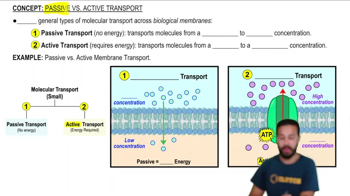
Exergonic processes are reactions that release energy, while endergonic processes require energy input. The synthesis of ATP from ADP is an endergonic process, as it requires energy to form the high-energy phosphate bonds, contrasting with the exergonic hydrolysis of ATP that releases energy for cellular activities.