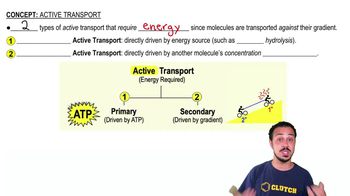
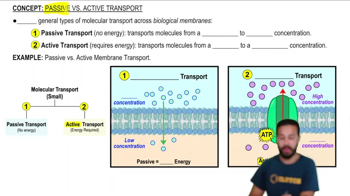
A substance moving across a membrane against a concentration gradient is moving by .
a. passive transport;
b. osmosis;
c. facilitated diffusion;
d. active transport;
e. diffusion
검증된 단계별 안내
1
Identify the key concept: A substance moving against a concentration gradient.
Understand that moving against a concentration gradient requires energy input.
Recall that passive transport, osmosis, facilitated diffusion, and diffusion do not require energy.
Recognize that active transport is the process that requires energy to move substances against a concentration gradient.
Conclude that the correct answer involves a process that uses energy to move substances across a membrane.
비슷한 문제에 대한 검증된 영상 답변:
이 영상 해법은 위 문제에 도움이 된다고 튜터들이 추천한 것입니다.
영상 길이:
47s
영상 재생:
0 댓글
주요 개념
질문에 올바르게 답하기 위해 반드시 이해해야 하는 핵심 개념들은 다음과 같습니다.
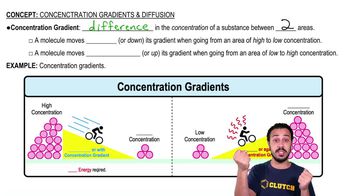
Concentration Gradient
A concentration gradient refers to the difference in the concentration of a substance across a space or membrane. Substances naturally move from areas of higher concentration to areas of lower concentration, a process that is fundamental to understanding transport mechanisms in cells.
Active transport is the process by which substances move across a cell membrane against their concentration gradient, requiring energy, typically in the form of ATP. This mechanism is crucial for maintaining cellular homeostasis and allowing cells to uptake necessary nutrients even when they are in lower concentrations outside the cell.
Passive transport is the movement of substances across a cell membrane without the use of energy, occurring along the concentration gradient. This includes processes like diffusion, osmosis, and facilitated diffusion, where molecules move from areas of higher concentration to lower concentration until equilibrium is reached.

 0:47분
0:47분 검증된 단계별 안내
 04:51
04:51