Which of the following is an important exception to the central dogma of molecular biology?
a. Many genes code for RNAs that function directly in the cell.
b. DNA is the repository of genetic information in all cells.
c. Messenger RNA is a short-lived 'information carrier.'
d. Proteins are responsible for most aspects of the phenotype.
검증된 단계별 안내
1
Identify the central dogma of molecular biology, which states that genetic information flows from DNA to RNA to protein.
Consider each option and determine how it relates to the central dogma.
Option a: Many genes code for RNAs that function directly in the cell. This suggests that not all RNA is translated into protein, which is an exception to the central dogma.
Option b: DNA is the repository of genetic information in all cells. This aligns with the central dogma as DNA is the starting point of genetic information flow.
Option c: Messenger RNA is a short-lived 'information carrier.' This describes the role of mRNA in the central dogma, carrying information from DNA to the ribosome.
Option d: Proteins are responsible for most aspects of the phenotype. This is consistent with the central dogma, as proteins are the end products of gene expression.
비슷한 문제에 대한 검증된 영상 답변:
이 영상 해법은 위 문제에 도움이 된다고 튜터들이 추천한 것입니다.
영상 길이:
31s
영상 재생:
0 댓글
주요 개념
질문에 올바르게 답하기 위해 반드시 이해해야 하는 핵심 개념들은 다음과 같습니다.
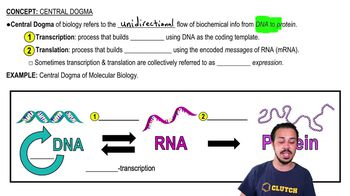
Central Dogma of Molecular Biology
The central dogma of molecular biology describes the flow of genetic information within a biological system. It outlines the process where DNA is transcribed into RNA, which is then translated into proteins. This framework is fundamental for understanding how genetic information is expressed and regulated in cells.
While the central dogma emphasizes the role of RNA as a messenger between DNA and proteins, many genes also code for non-coding RNAs that perform essential functions in the cell. These RNAs, such as ribosomal RNA (rRNA) and transfer RNA (tRNA), are crucial for protein synthesis and regulation, highlighting an important exception to the traditional view of RNA's role.
The phenotype of an organism is the observable physical and biochemical characteristics, which result from the expression of its genes. While proteins play a significant role in determining phenotype, the influence of non-coding RNAs and environmental factors also contributes to the complexity of gene expression and phenotypic variation, challenging the simplistic view of the central dogma.

 0:31분
0:31분 검증된 단계별 안내
 05:45
05:45