Skip to main content
Anatomy & Physiology
나의 코스
배우기
시험 준비
AI 튜터
학습 가이드
교과서적 해결책
플래시카드
탐험해 보세요
앱을 사용해 보세요
나의 코스
배우기
시험 준비
AI 튜터
학습 가이드
교과서적 해결책
플래시카드
탐험해 보세요
앱을 사용해 보세요
뒤로
Action Potentials quiz
카드를 뒤집기 위해 탭할 수 있습니다.
What is the resting membrane potential of a neuron before an action potential begins?
카드를 뒤집기 위해 탭할 수 있습니다.
👆
What is the resting membrane potential of a neuron before an action potential begins?
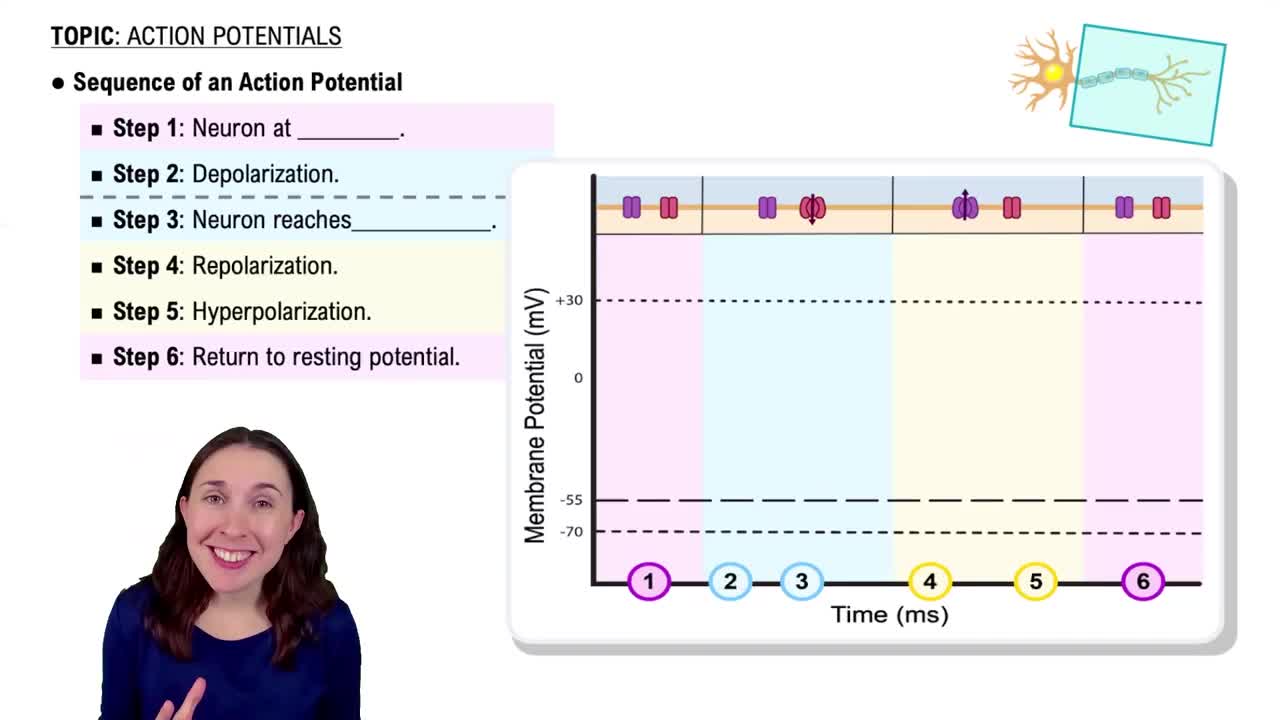
The resting membrane potential is -70 millivolts.
진행 상황 추적
컨트롤 버튼이 '내비게이션' 모드로 변경되었습니다.
1/15
관련 플래시카드
관련 실천
추천 영상
Action Potentials definitions
Action Potentials
15 용어
Action Potentials
11. Nervous Tissue and Nervous System
7 문제점
주제
Bruce
The Refractory Period
11. Nervous Tissue and Nervous System
3 문제점
주제
Jason
11. Nervous Tissue and Nervous System - Part 1 of 2
5 주제
8 문제점
장
Bruce
11. Nervous Tissue and Nervous System - Part 2 of 2
3 주제
8 문제점
장
Jason
02:36
Action Potentials Example 1
8071
views
164
rank
5
comments
03:53
Action Potential
11160
views
224
rank
1
comments
이 집합의 용어 (15)
하이드의 정의
What is the resting membrane potential of a neuron before an action potential begins?
The resting membrane potential is -70 millivolts.
What triggers the opening of voltage-gated sodium channels during an action potential?
Voltage-gated sodium channels open when the membrane potential reaches the threshold of -55 millivolts.
What happens to sodium ions when voltage-gated sodium channels open?
Sodium ions rush into the neuron following their electrochemical gradient, causing depolarization.
To what value does the membrane potential rise during massive depolarization?
The membrane potential rises to about +30 millivolts.
What occurs at +30 millivolts in the action potential sequence?
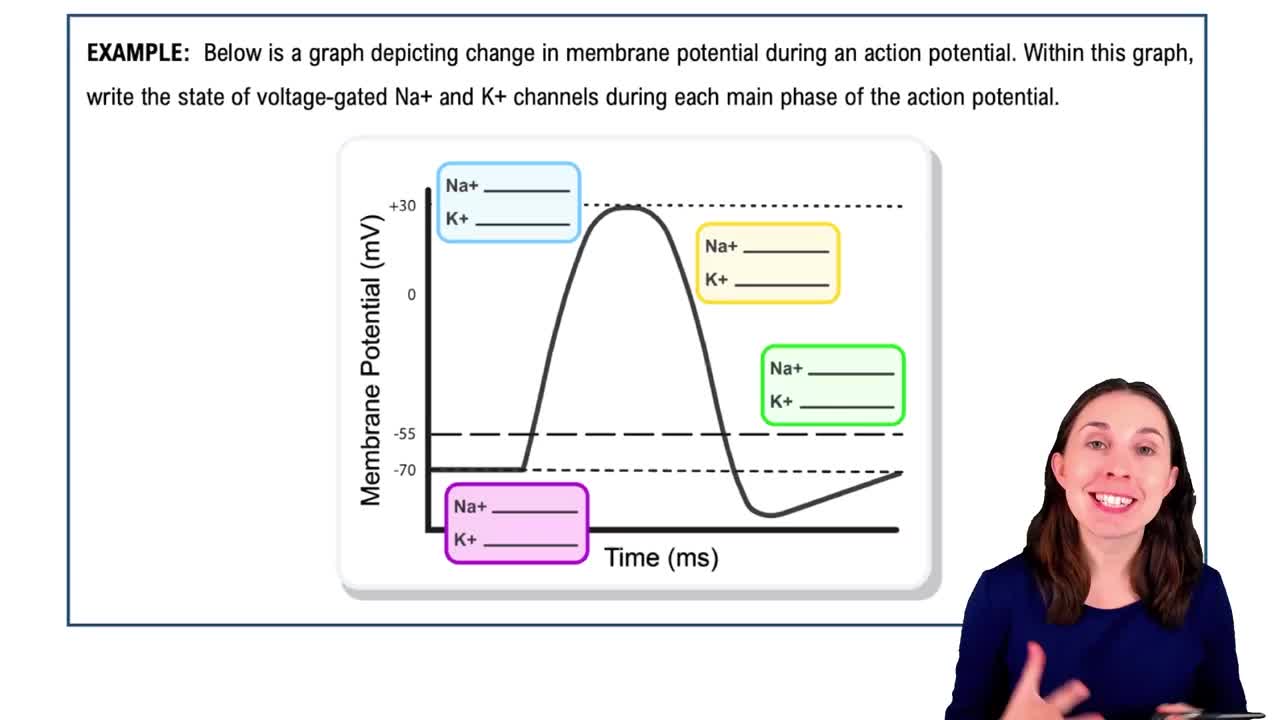
Voltage-gated sodium channels close and voltage-gated potassium channels open.
What is the effect of opening voltage-gated potassium channels?
Potassium ions exit the cell, leading to repolarization as the membrane potential becomes more negative.
What is repolarization in the context of an action potential?
Repolarization is the process of returning the membrane potential toward its resting value after depolarization.
What is hyperpolarization and when does it occur during an action potential?
Hyperpolarization occurs when the membrane potential becomes more negative than the resting potential, typically reaching -80 to -90 millivolts.
At what membrane potential do voltage-gated potassium channels begin to close?
Voltage-gated potassium channels begin to close around -50 millivolts.
Why does the neuron overshoot its resting potential during repolarization?
The neuron overshoots because potassium channels close slowly, allowing extra potassium to leave the cell.
What restores the neuron to its resting potential after an action potential?
The sodium-potassium pump restores the neuron to its resting potential.
What is the role of EPSPs in initiating an action potential?
EPSPs depolarize the membrane, helping it reach the threshold needed to trigger an action potential.
What is the sequence of channel activity during an action potential?
First, sodium channels open and then close; next, potassium channels open and then slowly close.
What happens to the membrane potential when potassium leaves the cell?
The membrane potential becomes more negative, leading to repolarization and hyperpolarization.
What is the final step in the action potential cycle?
The sodium-potassium pump restores the membrane potential to -70 millivolts, completing the cycle.
 뒤로뒤로
뒤로뒤로

 02:36
02:36