Anatomy & Physiology
나의 코스
배우기
시험 준비
AI 튜터
학습 가이드
교과서적 해결책
플래시카드
탐험해 보세요
앱을 사용해 보세요
나의 코스
배우기
시험 준비
AI 튜터
학습 가이드
교과서적 해결책
플래시카드
탐험해 보세요
앱을 사용해 보세요
뒤로
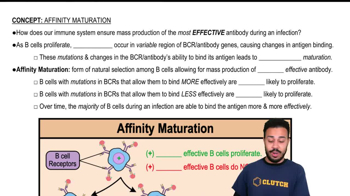
Affinity Maturation definitions
카드를 뒤집기 위해 탭할 수 있습니다.
Affinity Maturation
카드를 뒤집기 위해 탭할 수 있습니다.
👆
Affinity Maturation
A natural selection process among B cells enhancing antibody effectiveness over time.
진행 상황 추적
컨트롤 버튼이 '내비게이션' 모드로 변경되었습니다.
1/15
관련 플래시카드
추천 영상
Affinity Maturation quiz
Affinity Maturation
15 용어
7:27
Affinity Maturation
933
views
3
rank
이 집합의 용어 (15)
하이드의 정의
Affinity Maturation
A natural selection process among B cells enhancing antibody effectiveness over time.
B Cells
Immune cells that produce antibodies and undergo affinity maturation to improve antigen binding.
Plasma Cells
Differentiated B cells that secrete antibodies and participate in affinity maturation.
Antibody Class Switching
A process allowing B cells to change the class of antibody they produce for improved effectiveness.
Variable Region
Part of the BCR or antibody gene that controls the antigen binding site and undergoes mutations.
B Cell Receptors (BCRs)
Molecules on B cells that bind antigens and undergo mutations during affinity maturation.
Antigen
A substance that triggers an immune response, targeted by antibodies and BCRs.
Mutations
Genetic changes in BCRs that can enhance or reduce antibody binding to antigens.
Natural Selection
A process where B cells with beneficial mutations proliferate, enhancing antibody effectiveness.
Proliferation
The rapid multiplication of B cells with effective antigen binding during affinity maturation.
Clones
Identical B cells produced during proliferation, improving antigen binding over time.
Antibody
A protein produced by B cells that binds to specific antigens to neutralize them.
Immune System
The body's defense mechanism that uses processes like affinity maturation to fight infections.
Infection
The invasion of the body by harmful organisms, prompting an immune response.
Antigen Binding Site
The part of the antibody or BCR that directly interacts with the antigen.