Skip to main content
Anatomy & Physiology
나의 코스
배우기
시험 준비
AI 튜터
학습 가이드
교과서적 해결책
플래시카드
탐험해 보세요
앱을 사용해 보세요
나의 코스
배우기
시험 준비
AI 튜터
학습 가이드
교과서적 해결책
플래시카드
탐험해 보세요
앱을 사용해 보세요
뒤로
Electrolyte Balance definitions
카드를 뒤집기 위해 탭할 수 있습니다.
Osmosis
카드를 뒤집기 위해 탭할 수 있습니다.
👆
Osmosis
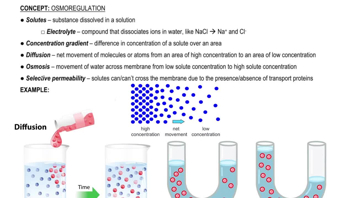
Water movement across a selectively permeable membrane from low to high solute concentration, balancing solute levels.
진행 상황 추적
컨트롤 버튼이 '내비게이션' 모드로 변경되었습니다.
1/15
관련 플래시카드
관련 실천
추천 영상
Electrolyte Balance quiz
Electrolyte Balance
15 용어
Electrolyte Balance
26. Fluid and Electrolyte Balance, Acid Base Balance
7 문제점
주제
Jason
Acid-Base Balance
26. Fluid and Electrolyte Balance, Acid Base Balance
7 문제점
주제
Jason
26. Fluid and Electrolyte Balance, Acid Base Balance
3 주제
9 문제점
장
Jason
VideoThumbView.guidedCourse
07:59
Osmosis and Osmolarity
1532
views
15
rank
이 집합의 용어 (15)
하이드의 정의
Osmosis
Water movement across a selectively permeable membrane from low to high solute concentration, balancing solute levels.
Diffusion
Movement of molecules or atoms from an area of high concentration to an area of low concentration, leading to even distribution.
Solute
Substance dissolved in a solution, contributing to the overall concentration and osmotic properties of the mixture.
Electrolyte
Type of solute that dissociates into ions when dissolved in water, enabling electrical conductivity in biological fluids.
Concentration Gradient
Difference in solute concentration across a region, driving passive movement of particles or water.
Selective Permeability
Property of a membrane that allows certain molecules to cross while restricting others, often via transport proteins.
Osmolarity
Measure of solute concentration, typically expressed as moles of dissolved solute per liter of solution.
Hyperosmotic Solution
Environment with higher solute concentration than another, causing water to leave cells and resulting in cell shrinkage.
Isoosmotic Solution
Condition where solute concentrations are equal inside and outside a cell, resulting in no net water movement.
Hypoosmotic Solution
Environment with lower solute concentration than another, leading to water entering cells and causing them to swell.
Osmoconformer
Organism that maintains internal osmolarity similar to its environment, often seen in marine species.
Osmoregulator
Organism that actively controls internal osmolarity, regardless of external environmental conditions.
Anhydrobiosis
Adaptation allowing survival in the absence of water by entering a desiccated, dormant state.
Transport Protein
Membrane component facilitating or restricting the passage of specific solutes across cell membranes.
Cryptobiosis
Extreme survival state characterized by metabolic suspension, enabling endurance through harsh conditions like dehydration.
 뒤로뒤로
뒤로뒤로
 07:59
07:59