Skip to main content
Anatomy & Physiology
나의 코스
배우기
시험 준비
AI 튜터
학습 가이드
교과서적 해결책
플래시카드
탐험해 보세요
앱을 사용해 보세요
나의 코스
배우기
시험 준비
AI 튜터
학습 가이드
교과서적 해결책
플래시카드
탐험해 보세요
앱을 사용해 보세요
뒤로
Gluconeogenesis quiz
1 학생이 이 점이 도움이 되었다고 느꼈습니다
카드를 뒤집기 위해 탭할 수 있습니다.
Which hormone promotes gluconeogenesis as a way to increase blood glucose levels?
카드를 뒤집기 위해 탭할 수 있습니다.
👆
Which hormone promotes gluconeogenesis as a way to increase blood glucose levels?
Cortisol is the hormone that promotes gluconeogenesis to increase blood glucose levels.
진행 상황 추적
컨트롤 버튼이 '내비게이션' 모드로 변경되었습니다.
1/10
관련 플래시카드
관련 실천
추천 영상
Gluconeogenesis definitions
Gluconeogenesis
15 용어
Gluconeogenesis quiz #1
Gluconeogenesis
10 용어
Gluconeogenesis
24. Metabolism and Nutrition
2 문제점
주제
Fatty Acid Oxidation
24. Metabolism and Nutrition
4 문제점
주제
24. Metabolism and Nutrition - Part 1 of 3
5 주제
9 문제점
장
24. Metabolism and Nutrition - Part 2 of 3
4 주제
5 문제점
장
24. Metabolism and Nutrition - Part 3 of 3
5 주제
8 문제점
장
VideoThumbView.guidedCourse
08:55
Gluconeogenesis 1
1499
views
VideoThumbView.guidedCourse
07:17
Gluconeogenesis 2
1049
views
이 집합의 용어 (10)
하이드의 정의
Which hormone promotes gluconeogenesis as a way to increase blood glucose levels?
Cortisol is the hormone that promotes gluconeogenesis to increase blood glucose levels.
Which enzyme is used both in gluconeogenesis and glycogenolysis?
Glucose 6-phosphatase is used in both gluconeogenesis and glycogenolysis.
What is the primary location of gluconeogenesis in the body?
Gluconeogenesis primarily occurs in the liver.
Which molecule is converted back to pyruvate for gluconeogenesis?
Lactate is converted back to pyruvate for gluconeogenesis.
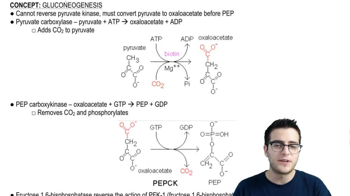
What is the role of pyruvate carboxylase in gluconeogenesis?
Pyruvate carboxylase converts pyruvate to oxaloacetate in gluconeogenesis.
Which enzyme reverses the action of phosphofructokinase in gluconeogenesis?
Fructose 1,6-bisphosphatase reverses the action of phosphofructokinase.
What is the energy requirement to produce one glucose molecule in gluconeogenesis?
Gluconeogenesis requires 2 pyruvate, 4 ATP, 2 GTP, and 2 NADH to produce one glucose molecule.
Which two amino acids cannot contribute to gluconeogenesis?
Lysine and leucine cannot contribute to gluconeogenesis.
What is the function of glucose 6-phosphatase in gluconeogenesis?
Glucose 6-phosphatase converts glucose 6-phosphate back to glucose.
Why are glycolysis and gluconeogenesis tightly regulated?
They are tightly regulated to prevent futile cycles where both pathways run simultaneously without net gain.
 뒤로뒤로
뒤로뒤로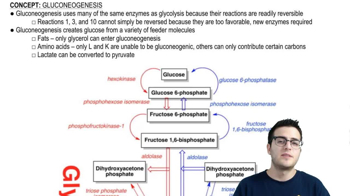
 08:55
08:55